← LinkedIn demo

AILANG×ap2-protocol.org

AI agent-ready generated 2026-05-14
agent-ready privacy portable

ap2-protocol.org scored 0/10 on agent-ready.

The radar shows AILANG-readiness across three commercial concerns. High means ap2-protocol.org is already strong there; low means AILANG could meaningfully help.

Why agent-ready scored 0/10
  • Page references /.well-known/agent.json — the A2A agent card discovery endpoint. Worth only 1pt: it's bleeding-edge (A2A protocol new in 2026), no commercial site has adopted it yet — keep it as a moonshot bonus, not a baseline expectation.
  • Page references /openapi.json, /openapi.yaml, or an OpenAPI schema URL.
  • Page references an MCP endpoint such as /mcp/ or /mcp/sse.
  • Page links to public API documentation, Swagger UI, or ReDoc.
  • Page mentions webhooks, callback URLs, or event subscriptions — the most agent-callable backend pattern.
  • Page documents rate limits, throttling, or 429 handling — agents need to know how to back off.
  • Page references Server-Sent Events, text/event-stream, or a streaming endpoint — agents that read incrementally land here.
  • Page mentions a sandbox, test mode, or test environment — lets agents practise against fake state before touching production.
  • Page documents OAuth, JWT, bearer tokens, API keys, or access tokens — agents can't call the API without knowing how to authenticate.
  • Page mentions idempotency, idempotency-key, or idempotent requests — agents need this to retry safely.
  • Page mentions AG-UI (Agent-User Interaction Protocol) — streams 16 typed lifecycle/text/tool/state events from agent backend to frontend over SSE or WebSocket.
  • Page mentions x402 (Coinbase's signed crypto payment payloads) or Cloudflare's pay-per-crawl (crawler-price header for AI-crawler monetisation). Both revive HTTP 402 for agents — Cloudflare joined the x402 Foundation, so they're one umbrella signal.
  • Page mentions AP2 (Agent Payments Protocol) — Google + Mastercard + 60 orgs. Cryptographically signed Mandates (Intent + Cart) authorise agents to spend on a user's behalf with price/timing/condition bounds.
  • Page mentions UTCP (Universal Tool Calling Protocol) — MCP alternative. Tools described in a JSON UTCPManual, called via their native protocols (HTTP/gRPC/CLI).

Full breakdown ↓ · View rubric ↗

Developers, merchants, and financial institutions involved in building, integrating, and regulating autonomous agent-based commerce and payment systems.

AP2 is an open protocol designed for secure, reliable, and interoperable agent commerce. It addresses authorization, authenticity, and accountability for agent-initiated payments, ensuring user control and privacy. Built on Verifiable Digital Credentials, AP2 aims to establish a trusted framework for the emerging Agent Economy among developers, merchants, and the payments industry.
Agent Payments Protocol (AP2) Verifiable Digital Credentials (VDCs) Agent Economy Agent2Agent (A2A) protocol Universal Commerce Protocol (UCP) Agent Authorization Framework

What AILANG Parse sees on ap2-protocol.org

Structural extraction — the same content an AI agent would consume from this page.

7 headings2 images8 lists0 tables4 linksHTML parsing by AILANG Parse

8 sections — page skeleton

1 header 4 navs 1 main 1 article 1 footer

7 headings

Agent Payments Protocol (AP2) What is AP2?¶ Why an Agent Payments Protocol is Needed¶ Core Principles and Goals¶ Key Concept: Verifiable Digital Credentials (VDCs)¶ See it in action

2 images

logoAgent Payments Protocol Logo

8 list items

Home [ Home ](.) Table of contents What is AP2? … [ Executive Summary ](overview/) Specification Specification [ Agent Payments Protoco… [ Agent Payments Protocol ](ap2/specification/) [ Agent Authorization Framework ](ap2/agent_authorization/) [ Flows ](ap2/flows/) [ Checkout Mandate ](ap2/checkout_mandate/) [ Payment Mandate ](ap2/payment_mandate/) [ Security and Privacy Considerations ](ap2/security_and_privacy_consideration… [ Implementation Considerations ](ap2/implementation_considerations/) [ Glossary ](glossary/) [ FAQ ](faq/)
Show the full extract — what AILANG Parse pulled from this page
# AP2 - Agent Payments Protocol Documentation

**Author:** Google

[Skip to content](#what-is-ap2)

*Header:*
[Image: logo]

[(link)](.)

AP2 - Agent Payments Protocol Documentation

Home

Initializing search

[AP2](https://github.com/google-agentic-commerce/AP2)

AP2 - Agent Payments Protocol Documentation

[AP2](https://github.com/google-agentic-commerce/AP2)

- Home
    
  [
    Home
    
  ](.)

      Table of contents
    

      What is AP2?
    

      Why an Agent Payments Protocol is Needed
    

      Core Principles and Goals
    

      Key Concept: Verifiable Digital Credentials (VDCs)
    

      See it in action
    

      Get Started and Build with Us
- What is AP2?
- Why an Agent Payments Protocol is Needed
- Core Principles and Goals
- Key Concept: Verifiable Digital Credentials (VDCs)
- See it in action
- Get Started and Build with Us
- [
    Executive Summary
    
  ](overview/)
- Specification


            Specification
          

[
    Agent Payments Protocol
    
  ](ap2/specification/)
[
    Agent Authorization Framework
    
  ](ap2/agent_authorization/)
[
    Flows
    
  ](ap2/flows/)
[
    Checkout Mandate
    
  ](ap2/checkout_mandate/)
[
    Payment Mandate
    
  ](ap2/payment_mandate/)
[
    Security and Privacy Considerations
    
  ](ap2/security_and_privacy_considerations/)
[
    Implementation Considerations
    
  ](ap2/implementation_considerations/)
- [
    Agent Payments Protocol
    
  ](ap2/specification/)
- [
    Agent Authorization Framework
    
  ](ap2/agent_authorization/)
- [
    Flows
    
  ](ap2/flows/)
- [
    Checkout Mandate
    
  ](ap2/checkout_mandate/)
- [
    Payment Mandate
    
  ](ap2/payment_mandate/)
- [
    Security and Privacy Considerations
    
  ](ap2/security_and_privacy_considerations/)
- [
    Implementation Considerations
    
  ](ap2/implementation_considerations/)
- [
    Glossary
    
  ](glossary/)
- [
    FAQ
    
  ](faq/)
- Samples


            Samples
          

[
    Human Present Cards
    
  ](https://github.com/google-agentic-commerce/AP2/tree/main/code/samples/python/scenarios/a2a/human-present/cards/)
[
    Human Present x402
    
  ](https://github.com/google-agentic-commerce/AP2/tree/main/code/samples/python/scenarios/a2a/human-present/x402/)
[
    Human Not Present Cards
    
  ](https://github.com/google-agentic-commerce/AP2/tree/main/code/samples/python/scenarios/a2a/human-not-present/cards/)
[
    Human Not Present x402
    
  ](https://github.com/google-agentic-commerce/AP2/tree/main/code/samples/python/scenarios/a2a/human-not-present/x402/)
[
    Digital Payment Credentials Android
    
  ](https://github.com/google-agentic-commerce/AP2/tree/main/code/samples/android/scenarios/digital-payment-credentials/run.sh)
- [
    Human Present Cards
    
  ](https://github.com/google-agentic-commerce/AP2/tree/main/code/samples/python/scenarios/a2a/human-present/cards/)
- [
    Human Present x402
    
  ](https://github.com/google-agentic-commerce/AP2/tree/main/code/samples/python/scenarios/a2a/human-present/x402/)
- [
    Human Not Present Cards
    
  ](https://github.com/google-agentic-commerce/AP2/tree/main/code/samples/python/scenarios/a2a/human-not-present/cards/)
- [
    Human Not Present x402
    
  ](https://github.com/google-agentic-commerce/AP2/tree/main/code/samples/python/scenarios/a2a/human-not-present/x402/)
- [
    Digital Payment Credentials Android
    
  ](https://github.com/google-agentic-commerce/AP2/tree/main/code/samples/android/scenarios/digital-payment-credentials/run.sh)

Table of contents

- What is AP2?
- Why an Agent Payments Protocol is Needed
- Core Principles and Goals
- Key Concept: Verifiable Digital Credentials (VDCs)
- See it in action
- Get Started and Build with Us

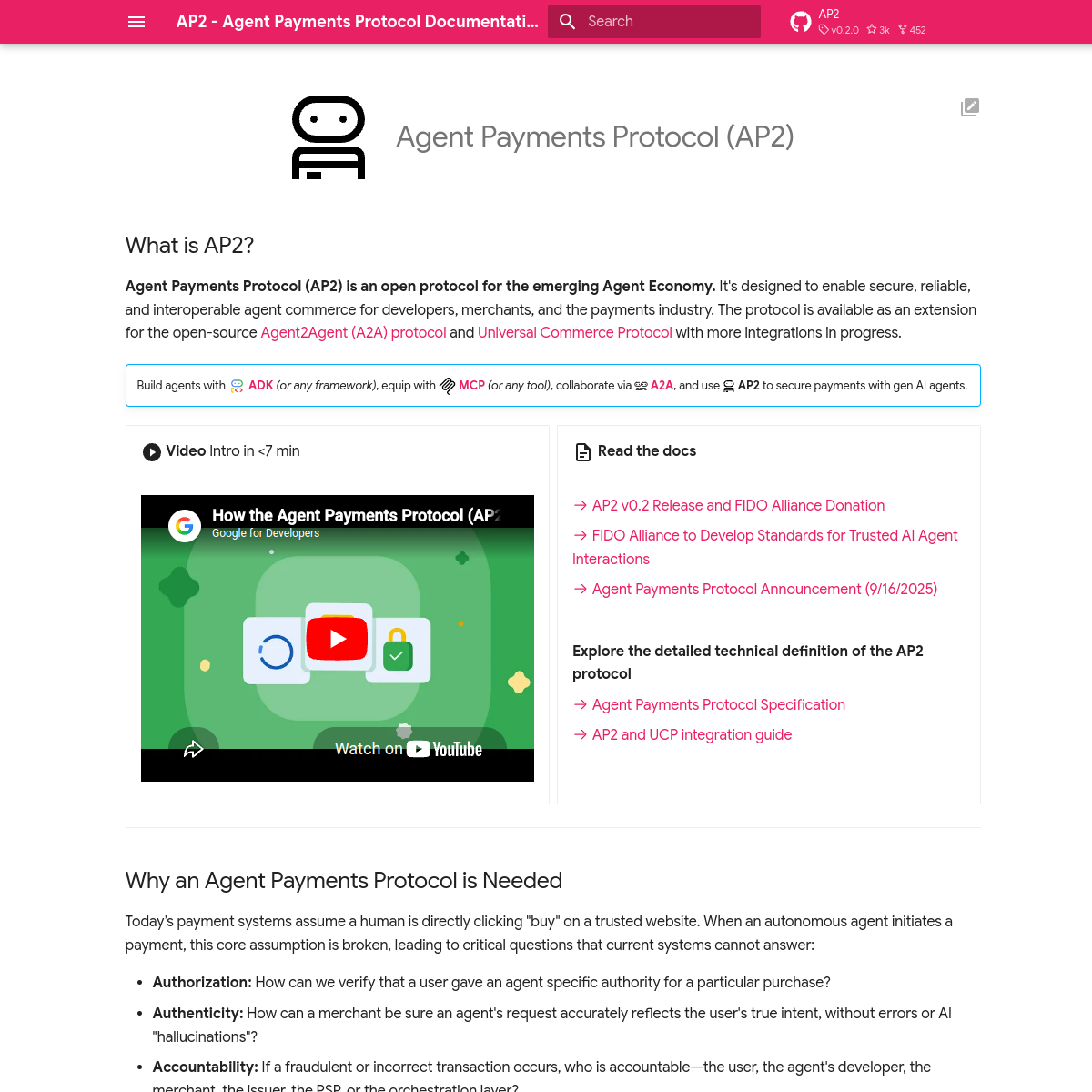
[Image: Agent Payments Protocol Logo]

# Agent Payments Protocol (AP2)

## What is AP2?

**Agent Payments Protocol (AP2) is an open protocol for the emerging Agent
Economy.** It's designed to enable secure, reliable, and interoperable agent
commerce for developers, merchants, and the payments industry. The protocol is
available as an extension for the open-source
[Agent2Agent (A2A) protocol](https://a2a-protocol.org/) and
[Universal Commerce Protocol](https://ucp.dev/documentation/ucp-and-ap2/) with more integrations
in progress.

Build agents with
**[ ADK](https://google.github.io/adk-docs/)***(or any framework)*, equip with
**[ MCP](https://modelcontextprotocol.io)***(or any tool)*, collaborate via
**[ A2A](https://a2a-protocol.org)**, and use
** AP2** to secure payments with gen AI agents.

- **Video** Intro in <7 min
- **Read the docs**
[ AP2 v0.2 Release and FIDO Alliance Donation](https://blog.google/products-and-platforms/platforms/google-pay/agent-payments-protocol-fido-alliance/)
[ FIDO Alliance to Develop Standards for Trusted AI Agent Interactions](https://fidoalliance.org/fido-alliance-to-develop-standards-for-trusted-ai-agent-interactions/)
[ Agent Payments Protocol Announcement (9/16/2025)](https://cloud.google.com/blog/products/ai-machine-learning/announcing-agents-to-payments-ap2-protocol)
**Explore the detailed technical definition of the AP2 protocol**
[ Agent Payments Protocol Specification](ap2/specification/)
[ AP2 and UCP integration guide](https://ucp.dev/documentation/ucp-and-ap2/)

---

## Why an Agent Payments Protocol is Needed

Today’s payment systems assume a human is directly clicking "buy" on a trusted
website. When an autonomous agent initiates a payment, this core assumption is
broken, leading to critical questions that current systems cannot answer:

- **Authorization:** How can we verify that a user gave an agent specific
    authority for a particular purchase?
- **Authenticity:** How can a merchant be sure an agent's request accurately
    reflects the user's true intent, without errors or AI "hallucinations"?
- **Accountability:** If a fraudulent or incorrect transaction occurs, who is
    accountable—the user, the agent's developer, the merchant, the issuer, the
    PSP, or the orchestration layer?

This ambiguity creates a crisis of trust that could significantly limit
adoption. Without a common protocol, we risk a fragmented ecosystem of
proprietary payment solutions, which would be confusing for users, expensive for
merchants, and difficult for financial institutions to manage. AP2 aims to
create a common language for any compliant agent to transact securely with any
compliant merchant globally.

---

## Core Principles and Goals

The Agent Payments Protocol is built on fundamental principles designed to
create a secure and fair ecosystem:

- **Openness and Interoperability:** As a non-proprietary, open extension for
    A2A and MCP, AP2 fosters a competitive environment for innovation, broad
    merchant reach, and user choice.
- **User Control and Privacy:** The user must always be in control. The
    protocol is designed with privacy at its core, using a role-based
    architecture to protect sensitive payment details and personal information.
- **Verifiable Intent, Not Inferred Action:** Trust in payments is anchored to
    deterministic, non-repudiable proof of intent from the user, directly
    addressing the risk of agent error or hallucination.
- **Clear Transaction Accountability:** AP2 provides a non-repudiable,
    cryptographic audit trail for every transaction, aiding in dispute
    resolution and building confidence for all participants.
- **Global and Future-Proof:** Designed as a global foundation, the initial
    version supports common "pull" payment methods like credit and debit cards.
    The roadmap includes e-wallets, "push" payments such as real-time bank
    transfers (e.g., UPI and PIX), and digital currencies, recognizing that
    many countries do not have real-time banking systems.

---

## Key Concept: Verifiable Digital Credentials (VDCs)

The Agent Payments Protocol engineers trust into the system using **verifiable
digital credentials (VDCs)**. VDCs are tamper-evident, cryptographically signed
digital objects that serve as the building blocks of a transaction. There are
two primary types of mandates, each existing in two stages:

- **Checkout Mandate**: Captures the reference to the specific items and
  purchase details negotiated between the agent and the merchant, and is
  **shared with the merchant**.

**Open**: Captures the user's constraints and goals for the transaction
  before a specific cart is finalized for autonomous execution.
**Closed**: Captures the user's (or agent's) authorization for a specific,
  finalized checkout.
- **Open**: Captures the user's constraints and goals for the transaction
  before a specific cart is finalized for autonomous execution.
- **Closed**: Captures the user's (or agent's) authorization for a specific,
  finalized checkout.
- **Payment Mandate**: Authorizes a payment against a specific payment
  instrument, and is **shared with the Credential Provider, Networks and the
  Merchant Payment Processor**.

**Open**: Captures the user's constraints on payment (e.g., budget,
  allowed instruments) for autonomous execution.
**Closed**: Captures the authorization for a specific transaction amount
  bound to a finalized checkout.
- **Open**: Captures the user's constraints on payment (e.g., budget,
  allowed instruments) for autonomous execution.
- **Closed**: Captures the authorization for a specific transaction amount
  bound to a finalized checkout.

These VDCs operate within a defined role-based architecture and are chained
together to provide a complete, verifiable audit trail for both human-present
and human-not-present transactions.

See more in the sample [Flows](ap2/flows/).

## See it in action

- **Human Not Present Cards**
A sample demonstrating an autonomous transaction where the agent acts without human presence, using traditional card payments.
[ Go to sample](https://github.com/google-agentic-commerce/AP2/tree/main/code/samples/python/scenarios/a2a/human-not-present/cards/)
- **Human Not Present x402**
A sample demonstrating an autonomous transaction where the agent acts without human presence, using the x402 protocol for payments.
[ Go to sample](https://github.com/google-agentic-commerce/AP2/tree/main/code/samples/python/scenarios/a2a/human-not-present/x402/)
- **Digital Payment Credentials Android**
A sample demonstrating the use of digital payment credentials on an Android device.
[ Go to sample](https://github.com/google-agentic-commerce/AP2/tree/main/code/samples/android/scenarios/digital-payment-credentials/)
- **Human Present Cards**
A sample demonstrating a human-present transaction using traditional card payments.
[ Go to sample](https://github.com/google-agentic-commerce/AP2/tree/main/code/samples/python/scenarios/a2a/human-present/cards/)

---

## Get Started and Build with Us

The Agent Payments Protocol provides a mechanism for secure payments, and it's
part of a larger picture to unlock the full potential of agent-enabled commerce.
We actively seek your feedback and contributions to help build the future of
commerce.

Our public GitHub repo hosts the lastest version of AP2 specification, documentation and SDK. Standardization of the specification will continue within the Agentic Authentication Technical and Payments Technical Working Groups in FIDO.

You can get started today by:

- Downloading and running our **code samples**.
- **Experimenting with the protocol** and its different agent roles.
- Contributing your feedback and **code** to the public repository.

[Visit the GitHub Repository](https://github.com/google-agentic-commerce/AP2)

Back to top

*Footer:*
[Next
              

                Executive Summary](overview/)

Copyright 2025 Google. Licensed under the Apache License, Version 2.0.

Made with

[Material for MkDocs](https://squidfunk.github.io/mkdocs-material/)

page preview · the URL we fetched https://ap2-protocol.org/ ↗
Screenshot of ap2-protocol.org

Couldn't render a preview for this site. Open the URL in a new tab ↗

Screenshot via thum.io

ap2-protocol.org scored 0/10 on agent-ready. AILANG opportunity is therefore 10/10. Here's where it would land first.

REST + MCP + A2A + OpenAPI in one command

ailang serve-api takes your typed AILANG functions and exposes them as REST endpoints, MCP tools, A2A skills, and OpenAPI 3.1 docs simultaneously. One module, four agent surfaces.

ailang serve-api --port 8092 --mcp-http \
  pricing.ail catalogue.ail
-- POST /api/pricing/quote, MCP at /mcp/,
-- A2A at /.well-known/agent.json, OpenAPI at /api/_meta/redoc.
→ AILANG docs

Contract-verified tool calls

Every tool an agent can call has a contract. Bounds, refusal paths, type signatures — proven before the agent ever sees it. The agent cannot exceed the tool's declared authority.

func placeOrder(item: SKU, qty: int) -> Receipt
  requires { qty > 0, qty <= 10 }
  ensures  { result.total > 0.0 }
-- the MCP server exposes this with its contract intact.
→ AILANG docs

An MCP server for your own docs and tools

Generate an MCP server from your typed AILANG functions; the docs MCP exposes a submit_feedback tool so agents can flag issues back to the maintainer. The language and its consumers stay on the same wire.

-- The AILANG docs MCP server lets Claude / Cursor / any
-- MCP client query the language directly:
--   stdlib_search "URL encoding"
--   submit_feedback "..."
→ AILANG docs

How this page was made

func sketchSite(url: string<pii>, topic: Topic) -> Sketch
  ! {Net @limit=1, AI @limit=5, FS @limit=4, Process, Declassify}
SignalTopicResultPointsAILANG primitive
agent.json referencedagent-ready0/1ailang serve-api generates A2A agent cards automatically — bonus if you're an early adopter
openapi.json referencedagent-ready0/2ailang serve-api generates OpenAPI 3.1 from Hindley-Milner type signatures
MCP endpoint referencedagent-ready0/2ailang serve-api --mcp-http exposes typed functions as MCP tools
Public API docs linkedagent-ready0/2ailang serve-api hosts Swagger + ReDoc at /api/_meta/ by default
Webhooks documentedagent-ready0/2ailang serve-api handles webhooks as typed handler functions with effect-tracked side effects
Rate limits documentedagent-ready0/2Capability budgets — Net @limit=N is the symmetric server-side primitive for what agents see as rate limits
Streaming / SSE endpointagent-ready0/2std/stream — ssePost and Stream effect handle event-source endpoints with typed event types
Sandbox / test environment offeredagent-ready0/2ailang --ai-stub plus mock effect handlers — deterministic, capability-scoped fakes for any effect, including Net and AI
Authentication documentedagent-ready0/2std/jwt for verification, IFC labels (string / string) to keep credentials out of public sinks at the type level
Idempotency keys documentedagent-ready0/2Pure functions are idempotent by construction; requires/ensures contracts express idempotence as a static guarantee
AG-UI streaming protocolagent-ready0/1std/stream — the AG-UI event lifecycle (RUN_STARTED → TEXT_MESSAGE_CONTENT → TOOL_CALL_RESULT → RUN_FINISHED) is a textbook sum type. ADTs + exhaustive pattern matching make every event-type branch a compile error to skip.
HTTP 402 agent payments (x402 / pay-per-crawl)agent-ready1/1Net @endpoint-scoped capability budgets bound payment destinations; requires { amount <= budget } gates the payload; IFC labels keep the signed payment key out of public sinks. Same primitives cover x402 payload signing and Cloudflare's crawler-price negotiation.
AP2 Agent Payments Protocolagent-ready1/1Mandates ARE contracts. requires { intent.price <= mandate.maxPrice } + ensures { cart.total <= intent.price } is a one-to-one translation of an Intent/Cart Mandate into AILANG. Z3 can verify the bounds at compile time.
UTCP tool-calling protocolagent-ready0/1Typed function signatures are the manifest. ailang serve-api emits the same metadata as a UTCPManual (name, input/output schema, native endpoint) — direct-call discovery without a proxy server.
End-to-end encryption documentedprivacy0/2IFC labels (string) force decryption to flow through a typed boundary; the compiler refuses to publish sealed values without explicit declassification
Compliance certifications citedprivacy0/2requires/ensures contracts express machine-verifiable claims; capability budgets bound audit-trail effects; effect rows leave nothing un-declared
Data minimisation languageprivacy0/2Capability scoping — each Net call declares its endpoint in the effect row, so "doesn't sell" becomes a type-system-enforceable claim, not a marketing one
Third-party domains restrainedprivacy0/2Capability scoping — each Net call declares its endpoint in the effect row
Data residency / on-prem languageprivacy0/2Three-runtime deploy — same module runs in WASM (browser), Cloud Run, and native CLI
Single-vendor LLM languageportable2/2std/ai multi-provider — switch from Anthropic to Gemini to OpenAI without rewriting
Multiple AI providers citedportable0/2std/ai — one Step API across Anthropic, OpenAI, Gemini, OpenRouter, Ollama, and custom-package providers
Cross-runtime / deployment portabilityportable0/2Effect handlers as runtime adapters — same .ail runs as WASM in the browser, a Cloud Run container, and a native CLI; only the handlers change
BYO key / model-agnosticportable0/2AILANG WASM — the full interpreter ships as a browser bundle, so caller-held keys (BYOK), offline apps, and embedded demos all work client-side