← LinkedIn demo

AILANG×langchain.com

AI portable generated 2026-05-14
agent-ready privacy portable

langchain.com scored 7/10 on portable.

The radar shows AILANG-readiness across three commercial concerns. High means langchain.com is already strong there; low means AILANG could meaningfully help.

Why portable scored 7/10
  • Page copy that names one specific LLM provider (e.g. "powered by Claude") without portability claims.
  • Body mentions two or more named AI providers (Claude, GPT, Gemini, Mistral, Llama, etc.) — already vendor-multi.
  • Body mentions self-hosted, on-prem, WASM, Docker, Kubernetes, or "deploy anywhere" — runtime portability claimed.
  • Body mentions "bring your own key", "BYOK", "any LLM", or "model-agnostic" — caller controls the model.

Full breakdown ↓ · View rubric ↗

Developers and engineers engaged in building, deploying, and managing AI agents and applications.

LangChain is an open-source framework providing tools, architectures, and integrations for building AI agents. It integrates with LangSmith for observability, evaluation, and deployment, enabling developers to build, ship, and manage adaptable AI applications efficiently.
AI agents LangChain framework LangSmith platform LangGraph runtime model integrations agent architectures

What AILANG Parse sees on langchain.com

Structural extraction — the same content an AI agent would consume from this page.

13 headings34 images0 lists0 tables49 linksHTML parsing by AILANG Parse

12 sections — page skeleton

4 navs 1 main 6 sections 1 footer

13 headings

Build agents faster, your way Ship fast with proven agent patterns Open and neutral by design Customize without complexity Durable runtime Foundation: Introduction to LangChain - Python

34 images

Show the full extract — what AILANG Parse pulled from this page
# LangChain: Open Source AI Agent Framework | Build Agents Faster


Products

[LangSmith Platform](/langsmith-platform)

[Image]

Observability

See exactly what your agents are doing

[Observability
See exactly what your agents are doing](/langsmith/observability)

[Image]

Evaluation

Score and improve agent performance

[Evaluation
Score and improve agent performance](/langsmith/evaluation)

[Image]

Deployment

Ship and scale agents in production

[Deployment
Ship and scale agents in production](/langsmith/deployment)

[Image]

Fleet

Agents for the whole company

[Fleet
Agents for the whole company](/langsmith/fleet)

[Image]

Sandboxes

Run agent-generated code safely

[Sandboxes
Run agent-generated code safely](/langsmith/sandboxes)

Open Source Frameworks

[Image]

deepagents

Build long-running agents for complex tasks

[deepagents
Build long-running agents for complex tasks](/deep-agents)

[Image]

langchain

Quick start agents with any model provider

[langchain
Quick start agents with any model provider](/langchain)

[Image]

langgraph

Build reliable agents with low-level control

[langgraph
Build reliable agents with low-level control](/langgraph)

Learn

Resources

[Blog](/blog)

[Customer Stories](/customers)

[Guides](/resources)

[Max Agency](https://www.youtube.com/playlist?list=PLfaIDFEXuae3UwB1QGEjsRAr8BzCQss7s)

How-To

[LangChain Academy](https://academy.langchain.com/)

[YouTube](https://www.youtube.com/@LangChain)

[Documentation](https://docs.langchain.com/)

Community

[LangSmith for Startups](/startups)

[Meetups](https://luma.com/langchain?k=c)

[Community](/community)

[Docs](https://docs.langchain.com/)

Company

[About](/about)

[Careers](/careers)

[Partners](/langchain-partner-network)

[Events](/events)

[Pricing](/pricing)

[Try LangSmith](https://smith.langchain.com/)

[Get a demo](/contact-sales)

[Try LangSmith](https://smith.langchain.com/)

[Get a demo](/contact-sales)

[Image]

langchain

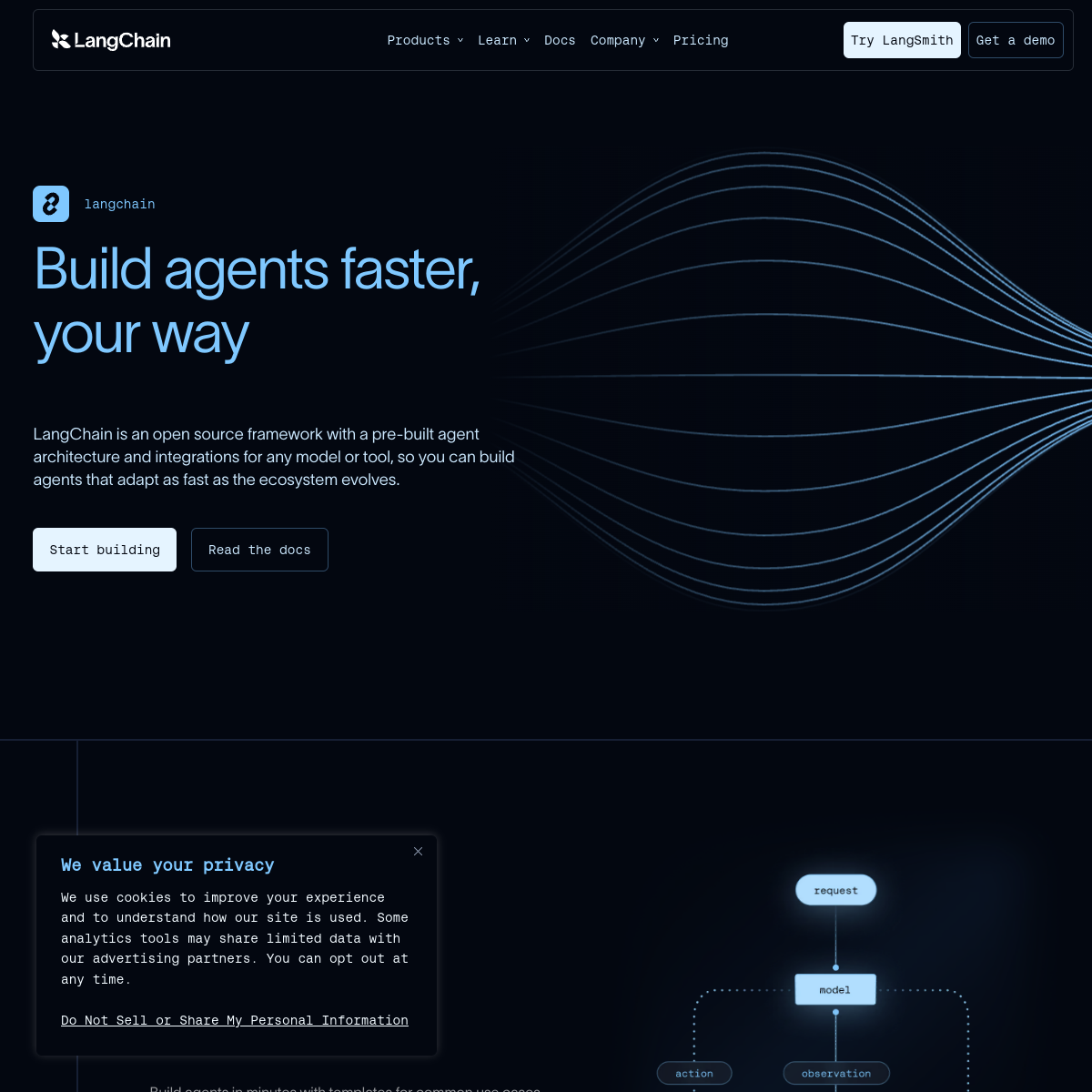
# Build agents faster,
your way

LangChain is an open source framework with a pre-built agent architecture and integrations for any model or tool, so you can build agents that adapt as fast as the ecosystem evolves.

[Start building](https://github.com/langchain-ai/langchain)

[Read the docs](https://docs.langchain.com/oss/python/langchain/overview)

[Image]

## Ship fast with proven agent patterns

Build agents in minutes with templates for common use cases. `create_agent` provides a proven ReAct pattern on LangGraph's durable runtime.

[Image]

[Image]

[Image]

## Open and neutral by design

Swap models, tools, and databases without rewriting your application. With 1000+ integrations, you can future-proof your stack as AI advances, with no vendor lock-in.

[Image]

[Image]

[Image]

## Customize without complexity

Extend agent behavior through middleware without rewriting core logic. Add human-in-the-loop approval, compress long conversations, or remove sensitive data— all with simple, composable hooks.

[Image]

[Image]

[Image]

## Durable runtime

`langchain` runs on `langgraph` 's  durable runtime — giving agents built-in persistence, rewind, checkpointing, and human-in-the-loop support.

[Image]

[Image]

[Image]

### Foundation: Introduction to LangChain - Python

[Image]

[.academy-link-img:hover .academy-img {
	transform: scale(0.95);
}](https://academy.langchain.com/courses/foundation-introduction-to-langchain-python)

Learn the basics of how to build agents with LangChain using pre-built architectures and model integrations in this LangChain Academy Course.

[Enroll for free](https://academy.langchain.com/courses/foundation-introduction-to-langchain-python)

[Image]

### Instantly connect to any model or data source

[See all our integrations](https://docs.langchain.com/oss/python/integrations/providers/overview)

[Image]

[(link)](https://docs.langchain.com/oss/python/integrations/providers/ollama)

[Image]

[(link)](https://docs.langchain.com/oss/python/integrations/providers/openai)

[Image]

[(link)](https://docs.langchain.com/oss/python/integrations/providers/aws)

[Image]

[(link)](https://docs.langchain.com/oss/python/integrations/providers/anthropic)

[Image]

[(link)](https://docs.langchain.com/oss/python/integrations/providers/google)

[Image]

[(link)](https://docs.langchain.com/oss/python/integrations/providers/groq)

[Image]

[(link)](https://docs.langchain.com/oss/python/integrations/providers/huggingface)

[Image]

[(link)](https://docs.langchain.com/oss/python/integrations/providers/databricks)

[Image]

[(link)](https://docs.langchain.com/oss/python/integrations/providers/pgvector)

[Image]

[(link)](https://docs.langchain.com/oss/python/integrations/providers/mistralai)

### FAQs for LangChain

Is LangChain open source?

Yes - LangChain is an MIT-licensed open-source library and is free to use.

How do I use LangChain with LangSmith?

LangChain is an open source framework with pre-built agent architectures and as integrations to models, tools, and databases to start building agents quickly. The LangChain framework integrates seamlessly with LangSmith, our platform for agent observability, evaluation, and deployment — you can set just one environment variable to get started.

### See what your agent is really doing

LangSmith, our agent engineering platform, helps developers debug every agent decision, eval changes, and deploy in one click.

[Learn more](/langsmith-platform)

[Play around](https://smith.langchain.com/)

*Footer:*
###### Products

[LangSmith Platform](/langsmith-platform)

[LangSmith Observability](/langsmith/observability)

[LangSmith Evaluation](/langsmith/evaluation)

[LangSmith Deployment](/langsmith/deployment)

[LangSmith Fleet](/langsmith/fleet)

[LangSmith Sandboxes](/langsmith/sandboxes)

[Deep Agents](/deep-agents)

[LangChain](/langchain)

[LangGraph](/langgraph)

###### Resources

[Blog](/blog)

[Customer Stories](/customers)

[Guides](/resources)

[LangChain Academy](https://academy.langchain.com)

[Community](/join-community)

[Changelog](https://changelog.langchain.com/)

[Docs](https://docs.langchain.com/)

[Support](https://support.langchain.com/)

###### Company

[About](/about)

[Careers](/careers)

[Partners](/langchain-partner-network)

[Trust Center](https://trust.langchain.com/)

[Marketing Assets](https://drive.google.com/drive/folders/1cc_Wdd8k7J5wUONBMvtfIZH_BaYvonym)

[Events](/events)

###### Sign up for our newsletter to stay up to date

Thank you!

Your submission has been received!

Oops! Something went wrong while submitting the form.

[All systems operational](https://status.smith.langchain.com/)

[Privacy policy](/privacy-policy)

[Terms of service](/terms-of-service)

page preview · the URL we fetched https://www.langchain.com/langchain ↗
Screenshot of langchain.com

Couldn't render a preview for this site. Open the URL in a new tab ↗

Screenshot via thum.io

langchain.com scored 7/10 on portable. AILANG opportunity is therefore 3/10. Here's where it would land first.

Same module, any LLM — picked at the CLI

Provider selection isn't a code edit — it's a flag on the run command. The exact same compiled .ail file talks to Anthropic, Google, OpenAI, OpenRouter or local Ollama depending on what you pass to `--ai`. Vendor lock-in becomes a shell-history concern.

# Same chat.ail, three vendors — no source change.
ailang run --ai claude-haiku-4-5  chat.ail
ailang run --ai gemini-2.5-flash chat.ail
ailang run --ai gpt-5.1-nano     chat.ail
# std/ai dispatches to each provider's native API.
→ AILANG docs

Structured output, portable across providers

callJson(prompt, schema) maps to each provider's native structured-output primitive — responseSchema for Gemini, response_format for OpenAI, forced-tool for Anthropic. Your schema, their plumbing.

let result = callJson(prompt, intentSchema);
-- same AILANG code, four different provider paths underneath.
→ AILANG docs

OpenRouter routing with replayable resolution

Reach SOTA open-source models through OpenRouter; the resolved model ID is logged so the eval is replayable months later, even if the upstream router has moved on.

call(prompt, model = "openrouter/meta-llama/llama-4-405b");
-- the eval harness pins the exact resolved model ID.
→ AILANG docs

How this page was made

func sketchSite(url: string<pii>, topic: Topic) -> Sketch
  ! {Net @limit=1, AI @limit=5, FS @limit=4, Process, Declassify}
SignalTopicResultPointsAILANG primitive
agent.json referencedagent-ready0/1ailang serve-api generates A2A agent cards automatically — bonus if you're an early adopter
openapi.json referencedagent-ready0/2ailang serve-api generates OpenAPI 3.1 from Hindley-Milner type signatures
MCP endpoint referencedagent-ready0/2ailang serve-api --mcp-http exposes typed functions as MCP tools
Public API docs linkedagent-ready0/2ailang serve-api hosts Swagger + ReDoc at /api/_meta/ by default
Webhooks documentedagent-ready0/2ailang serve-api handles webhooks as typed handler functions with effect-tracked side effects
Rate limits documentedagent-ready2/2Capability budgets — Net @limit=N is the symmetric server-side primitive for what agents see as rate limits
Streaming / SSE endpointagent-ready0/2std/stream — ssePost and Stream effect handle event-source endpoints with typed event types
Sandbox / test environment offeredagent-ready2/2ailang --ai-stub plus mock effect handlers — deterministic, capability-scoped fakes for any effect, including Net and AI
Authentication documentedagent-ready0/2std/jwt for verification, IFC labels (string / string) to keep credentials out of public sinks at the type level
Idempotency keys documentedagent-ready0/2Pure functions are idempotent by construction; requires/ensures contracts express idempotence as a static guarantee
AG-UI streaming protocolagent-ready0/1std/stream — the AG-UI event lifecycle (RUN_STARTED → TEXT_MESSAGE_CONTENT → TOOL_CALL_RESULT → RUN_FINISHED) is a textbook sum type. ADTs + exhaustive pattern matching make every event-type branch a compile error to skip.
HTTP 402 agent payments (x402 / pay-per-crawl)agent-ready0/1Net @endpoint-scoped capability budgets bound payment destinations; requires { amount <= budget } gates the payload; IFC labels keep the signed payment key out of public sinks. Same primitives cover x402 payload signing and Cloudflare's crawler-price negotiation.
AP2 Agent Payments Protocolagent-ready0/1Mandates ARE contracts. requires { intent.price <= mandate.maxPrice } + ensures { cart.total <= intent.price } is a one-to-one translation of an Intent/Cart Mandate into AILANG. Z3 can verify the bounds at compile time.
UTCP tool-calling protocolagent-ready0/1Typed function signatures are the manifest. ailang serve-api emits the same metadata as a UTCPManual (name, input/output schema, native endpoint) — direct-call discovery without a proxy server.
End-to-end encryption documentedprivacy0/2IFC labels (string) force decryption to flow through a typed boundary; the compiler refuses to publish sealed values without explicit declassification
Compliance certifications citedprivacy0/2requires/ensures contracts express machine-verifiable claims; capability budgets bound audit-trail effects; effect rows leave nothing un-declared
Data minimisation languageprivacy0/2Capability scoping — each Net call declares its endpoint in the effect row, so "doesn't sell" becomes a type-system-enforceable claim, not a marketing one
Third-party domains restrainedprivacy0/2Capability scoping — each Net call declares its endpoint in the effect row
Data residency / on-prem languageprivacy0/2Three-runtime deploy — same module runs in WASM (browser), Cloud Run, and native CLI
Single-vendor LLM languageportable2/2std/ai multi-provider — switch from Anthropic to Gemini to OpenAI without rewriting
Multiple AI providers citedportable2/2std/ai — one Step API across Anthropic, OpenAI, Gemini, OpenRouter, Ollama, and custom-package providers
Cross-runtime / deployment portabilityportable0/2Effect handlers as runtime adapters — same .ail runs as WASM in the browser, a Cloud Run container, and a native CLI; only the handlers change
BYO key / model-agnosticportable2/2AILANG WASM — the full interpreter ships as a browser bundle, so caller-held keys (BYOK), offline apps, and embedded demos all work client-side