
Back to Case Studies
AILANG

AI-Generated Code That's Cheaper to Debug, Replay, and Fix

AILANG is a programming language built on 12 design axioms that make AI-generated code deterministic, traceable, and safe. Integrates with Claude Code, Gemini CLI, and other AI coding agents in 30 seconds.

Open Source v0.6.2 AI Coding Agents
AILANG Code Example
Deterministic Same input, same output
Effect Boundaries No hidden side effects
Structured Traces Full execution visibility
66 Examples Ready to learn

The Problem with AI-Generated Code

AI Writes Code Fast. Debugging It Is Slow.

AI coding agents like Claude Code and Gemini CLI can generate code rapidly, but when something goes wrong, you're left with traditional debugging: print statements, breakpoints, and guesswork. The AI can't replay its own execution or trace what happened.

AILANG's Solution: A language built from 12 design axioms that make every execution deterministic, traceable, and replayable. Side effects are explicit in types, so AI can't hallucinate unauthorized operations.

  • Deterministic execution: Same input produces same output, every time
  • Effect boundaries: Side effects visible in types, preventing hallucinated operations
  • Structured traces: Detailed execution logs organized by effect type
  • Budget constraints: Capabilities are statically visible and resource-limited
30-Second Setup

Integrates with Claude Code, Gemini CLI, and other AI coding agent plugin systems

Get Started

Built on 12 Design Axioms

AILANG's design principles ensure AI-generated code is predictable, debuggable, and safe by construction.

Deterministic Replay

Every execution can be replayed exactly. When debugging AI code, you can step through exactly what happened, not guess at state changes.

Explicit Authority

Capabilities like file access or network calls are statically visible in types. AI can't accidentally generate code that exceeds its permissions.

Structured Traces

Execution traces organized by effect type give you visibility into exactly what operations occurred and in what order.

AILANG Code Examples

Pure functional core with lambda calculus, pattern matching, and algebraic data types

Version 0.6.2

AI Agent Integration

Works with Claude Code, Gemini CLI, and other AI coding agent plugin systems

66 Code Examples

Comprehensive examples covering all language features and common patterns

Effect System

IO, File System, Clock, and Network effects with budget constraints

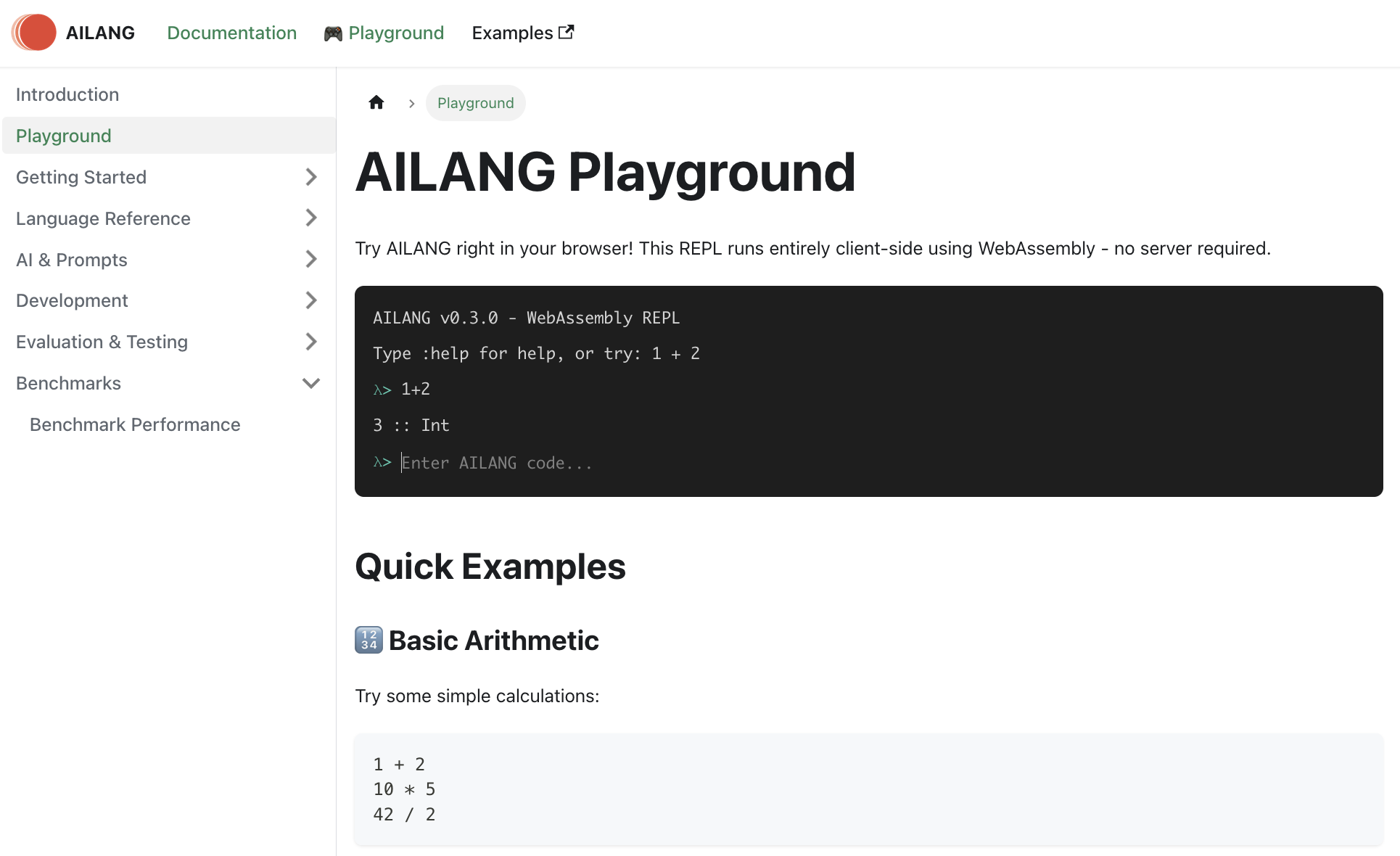
Interactive Playground

Browser-based REPL for experimenting without installation

Performance Benchmarks

Documented performance comparisons across major LLM models

Capability Security

Statically visible permissions prevent unauthorized operations

Why AILANG for AI Coding Agents?

The Debugging Problem:

  • Non-deterministic execution: Traditional languages make it hard to replay failures
  • Hidden side effects: AI can generate code with unexpected mutations
  • Implicit permissions: No way to constrain what operations AI code can perform
  • Opaque traces: Difficult to understand what happened during execution

AILANG's Approach:

  • Replay any execution: Deterministic semantics mean perfect reproducibility
  • Effects in types: Side effects are visible and constrained by the type system
  • Budget constraints: Limit resources AI code can consume
  • Structured traces: Organized logs by effect type for easy debugging

Why This Matters for AI Strategy

AILANG isn't just another programming language. It's built on a radical thesis about how AI systems should work.

"Machines as Primary Readers" — AILANG deliberately prioritizes machine reasoning over human ergonomics. Every design decision optimizes for AI analysis, not developer convenience.

The Context Window Problem

Research shows LLMs suffer 30-50% performance degradation as context grows from 10K to 1M tokens. Architectural reasoning is a key failure mode.

AILANG directly addresses this with:

  • Explicit effects: No need to trace through code to understand capabilities
  • Static imports: Dependencies are clear without scanning files
  • Deterministic semantics: Predictable behavior reduces reasoning overhead

Cost as Semantic Property

In AILANG, resource consumption—time, memory, I/O operations—is part of the program's meaning, not incidental detail.

This enables:

  • Budget constraints: Limit what AI code can consume
  • Predictable costs: Know resource usage before execution
  • Safe autonomy: AI agents that can't accidentally exhaust resources

What's Coming

61 features planned across 5 versions. Here's a glimpse of the roadmap.

Observability Dashboards

Unified OTEL dashboards with cross-process trace linking. See exactly what your AI agents are doing across distributed systems.

v0.6.4

Human-in-the-Loop Workflows

Dashboard approval systems for AI operations. Review and approve agent actions before they execute in production.

v0.6.4

Global Collaboration Hub

Cross-computer agent collaboration. Multiple AI agents working together across machines with shared semantic state.

v0.7.0

Coordinator Daemon

Always-on autonomous development daemon for continuous AI-driven improvements

Distributed Evaluation

Workers across cloud infrastructure for parallel execution and scaling

SMT Verification

Formal verification with redundant generation for provably correct AI code

CSP Concurrency

Session types for safe concurrent AI agent communication

Execution Profiles

Formalized modes for games, agents, and services with validated constraints

Symbolic Reasoning Kernel

AILANG as the foundation for AI systems that reason about their own code

Get Involved

AILANG is an active research project welcoming contributors of all backgrounds. Whether you're interested in programming language design, AI systems, or just curious about the future of coding, there are ways to participate.

For Researchers

Study Language Design Analyze AI Coding Patterns Publish Findings

For Contributors

Report Issues Suggest Features Submit Pull Requests

Ready to Make AI-Generated Code Debuggable?

Try AILANG with your favorite AI coding agent, or get in touch to discuss how it can improve your AI development workflow.