Travel as fast as you like. Live with the consequences.
One hand-wave, the Higgs bubble. Everything else is real special and general relativity, rendered from the real nearby stars: aberration, Doppler colour and beaming, time dilation, and the cosmic background turned to fire ahead of you.
One admitted hand-wave. Everything else is physics.
“The Higgs bubble is the one hand-wavy non-physics bit which we admit, but then be as hard-core physics for the rest as possible.” The bubble is defined by three properties. Every consequence, from the drag of interstellar gas to the glow ahead, is derived from them with ordinary physics and given a check value.
The Higgs bubble
A 100 m pocket made by the ship's generator. It has:
A wall that stops every massive particle and lets light and neutrinos through.
Tunable inertia for the whole pocket, never quite zero, so the ship can cruise at 0.9c to 0.999999c.
Its own frame inside: the crew never feel the boost; a generator holds a steady 1 g.
These clips are frame-exact captures of the Godot renderer driven by the AILANG simulation. No compositing, no grading: the HUD shows the simulation's own β, γ and clocks.
Runs today
Accelerate, and the sky folds forward
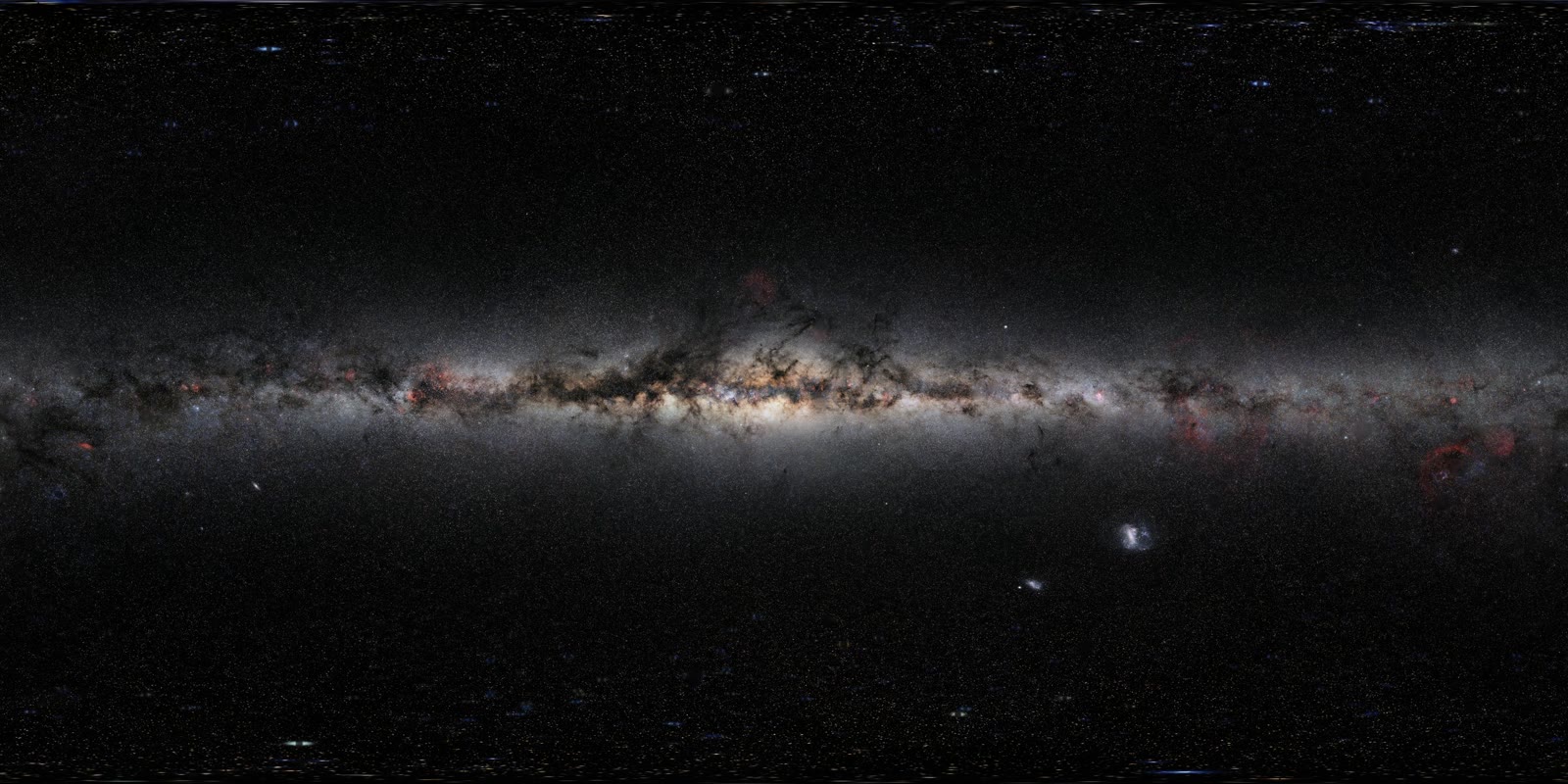
At rest you see the Milky Way across the sky. Burn at 1 g and aberration drags every star toward the bow: at 0.9c a star that sits 90° to the side at rest appears just 25.84° off the nose. Ahead, light is Doppler shifted blue and beamed brighter; behind, it reddens past the visible band and goes out.
Each star is a blackbody at its own Gaia colour temperature, shifted to D·T and scaled by its point-source flux ratio. The GPU shader is checked against a float64 CPU reference to under 0.1 px.
Runs today
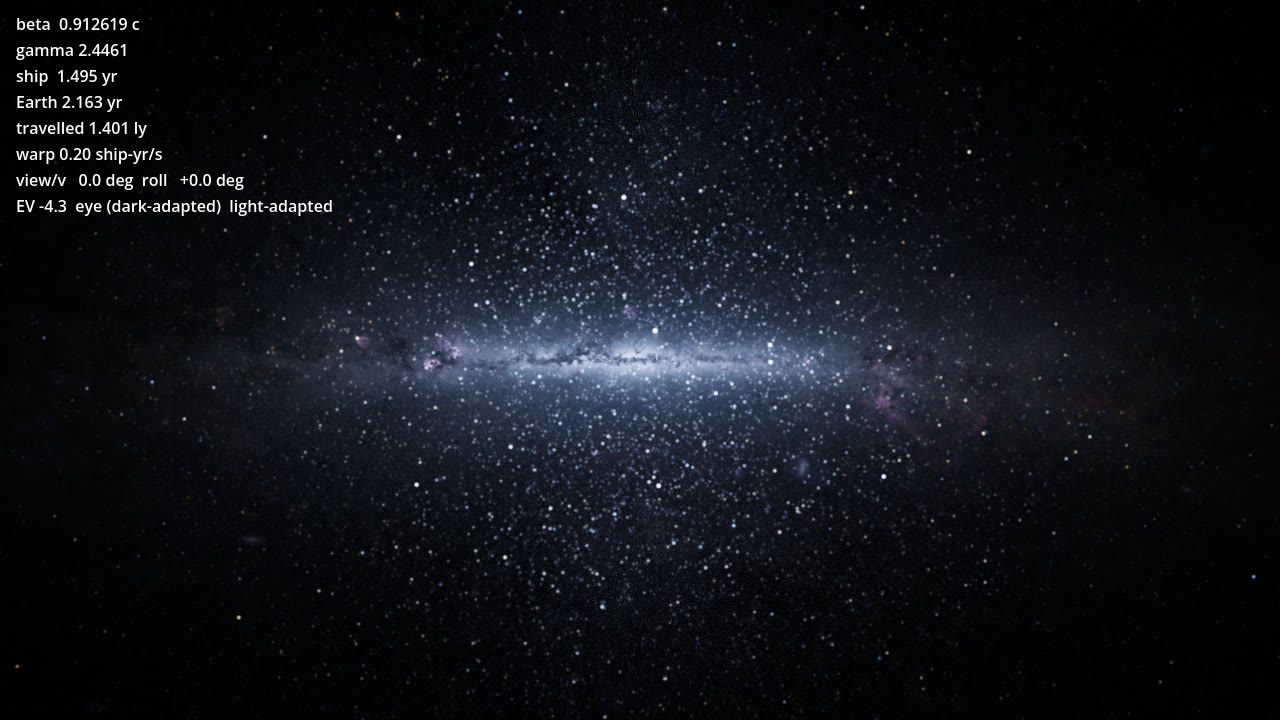
Look around at 0.99c
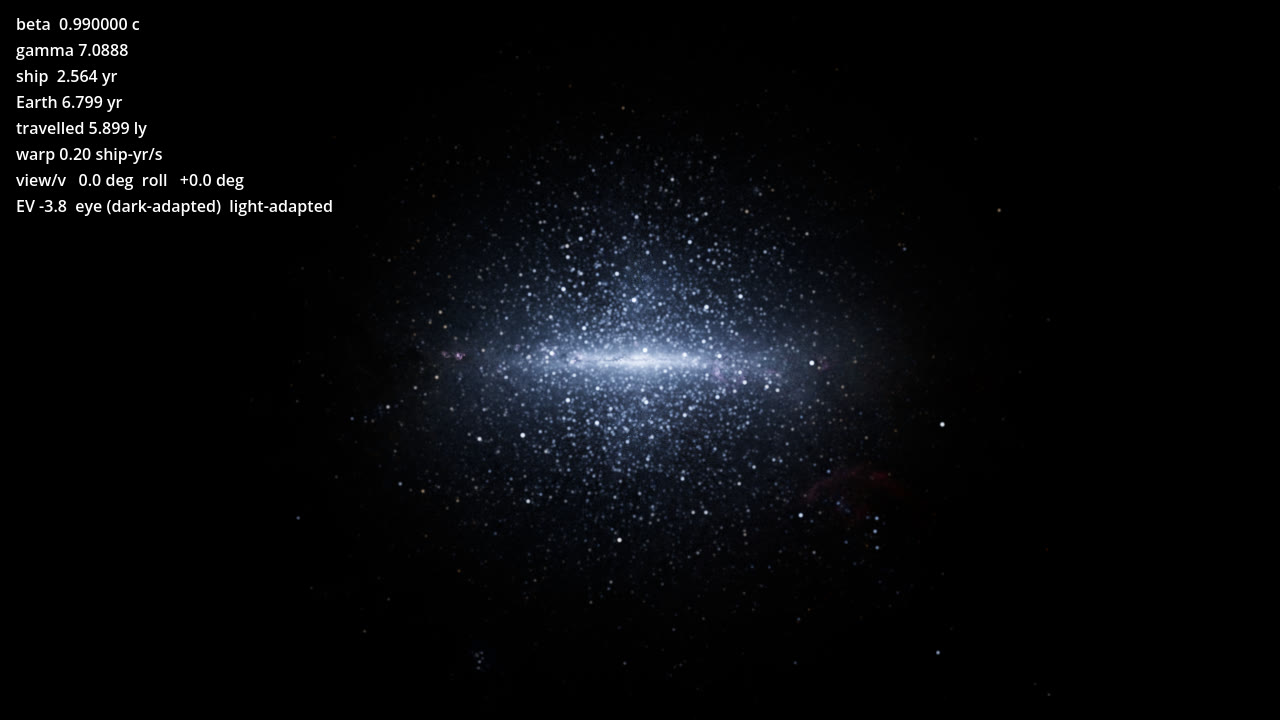
A full turn of the camera while cruising at γ 7.09. The whole visible universe sits in a bright window ahead. Turn to the beam and the sky is nearly empty; astern it is black. Nothing is faked to keep it pretty.
The exposure is honest too: by default it is a dark-adapted eye, calibrated so the naked-eye limit lands at V 6.9 (Crumey's model gives 6.897). Camera metering and readability aids exist, and the HUD says when they are on.
Runs today
The cosmic background, set on fire
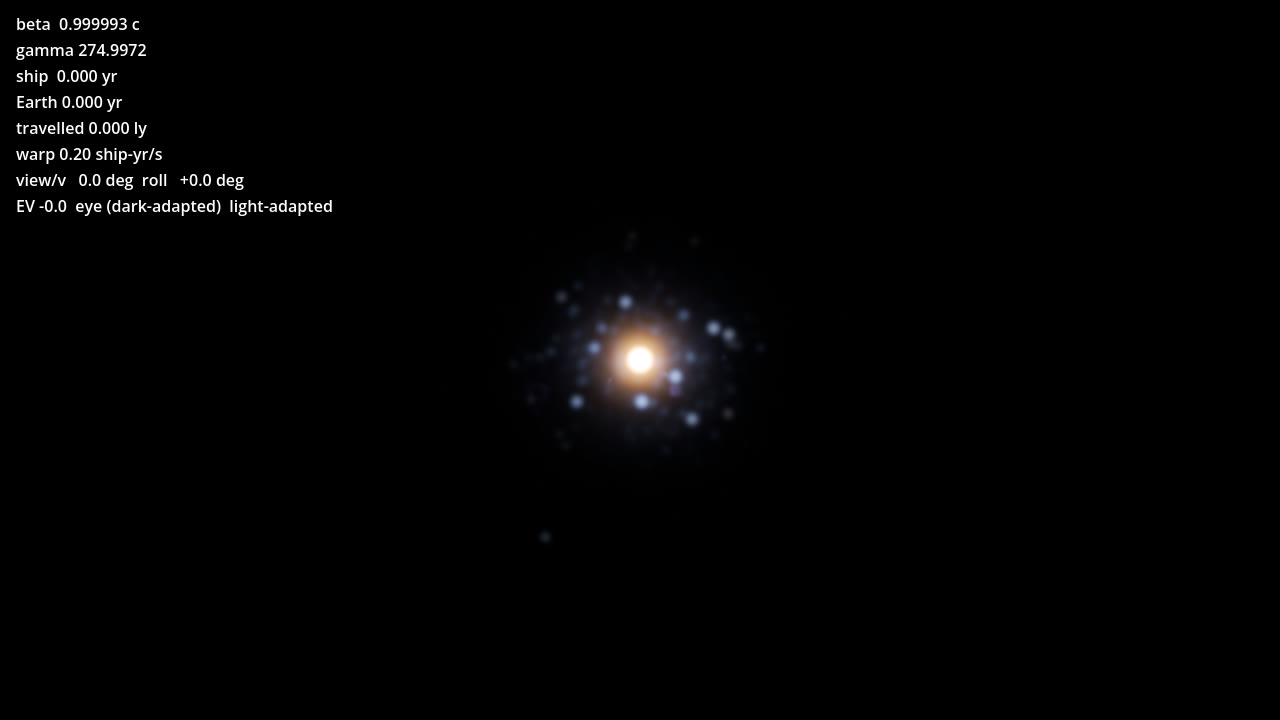
Push past γ 100 and something appears dead ahead that no star can explain: the 2.7 K microwave background, Doppler shifted into the visible. It shows faintly from γ ≈ 146, glows orange at γ ≈ 275 (1,500 K) and burns at 3,853.7 K at γ 707, the cruise cap.
Forward view through a 20° lens, γ 20 to 707 on a committed journey near Sol: first the stars crowd into a shrinking blue ball, then the CMB takes over the bow.
Runs today
Plan a journey. Then you cannot take it back
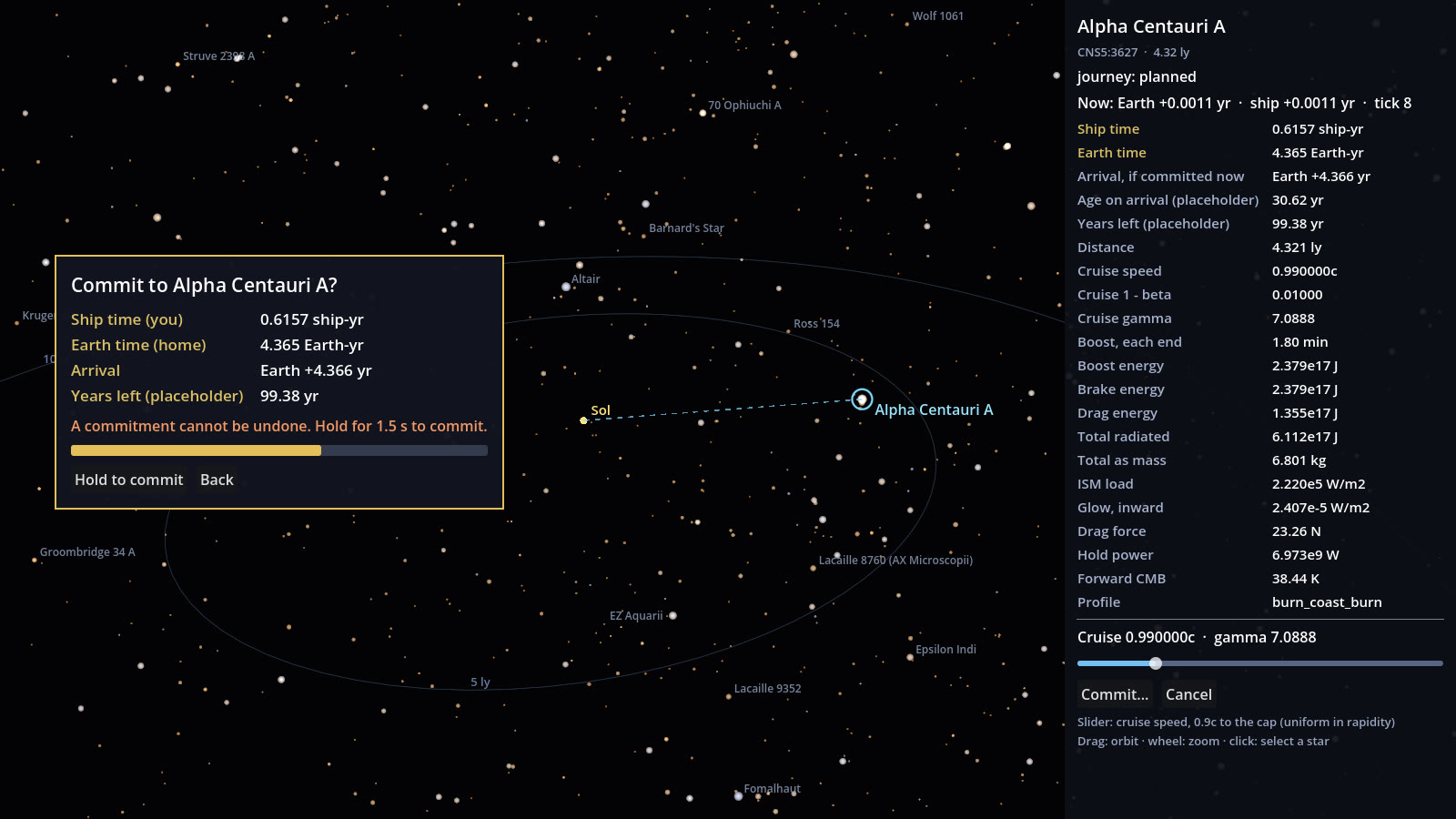
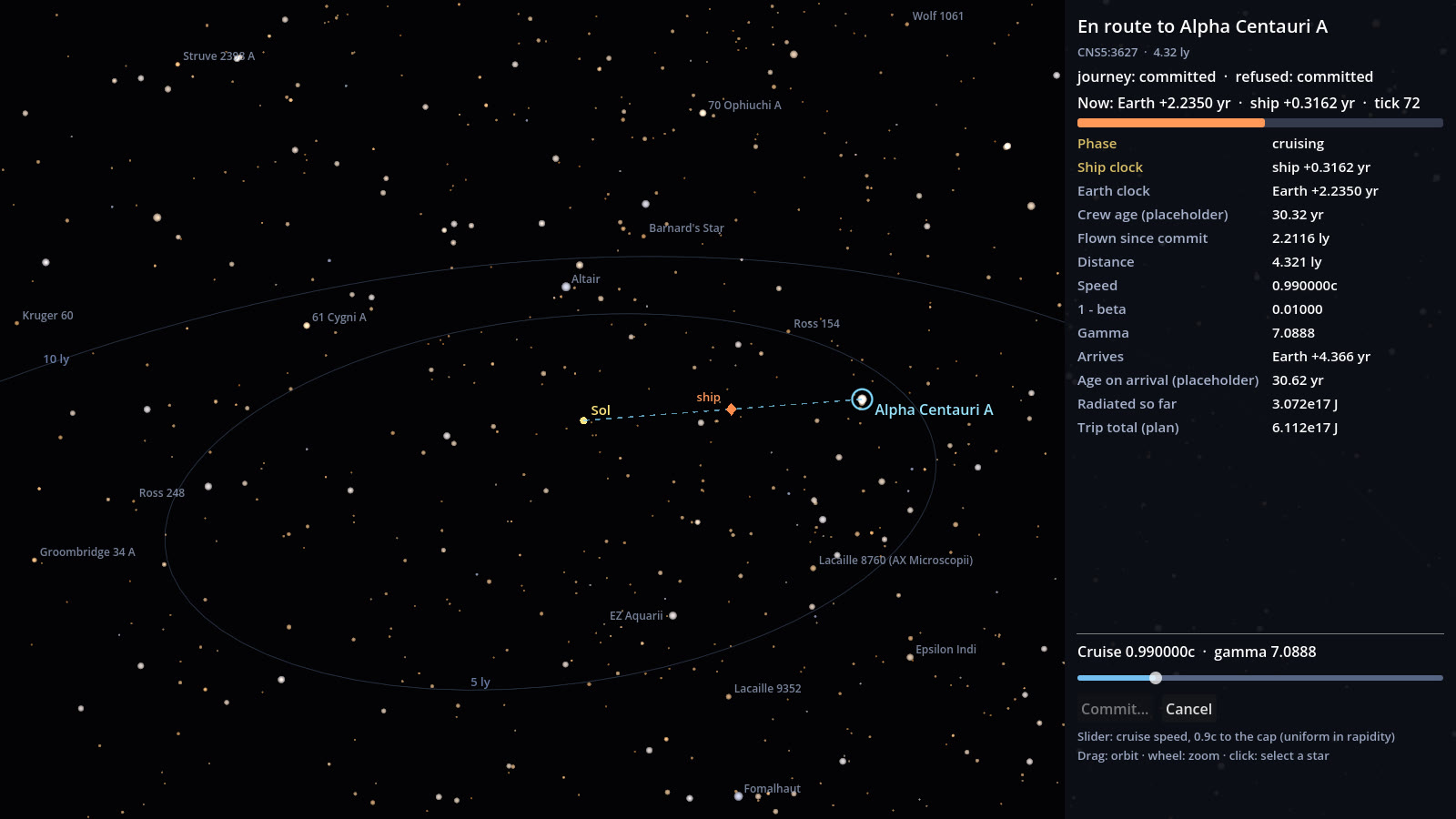
Pick a star, slide the cruise speed, and watch the two clocks part. α Centauri at 0.99c costs you 0.62 years and everyone at home 4.4. Faster costs you less and the galaxy more. Commit with a 1.5-second hold and the simulation refuses every attempt to cancel.
Every number on the panel comes from the AILANG simulation: the planner matches the closed form to 1e-9, with the boost, brake and interstellar-drag energy ledger beside it.
335,157
stars drawn, from CNS5, Gaia GCNS and Hipparcos
< 0.1 px
GPU shader against the float64 CPU reference
10,000
ticks replayed byte-identical on the VM and the interpreter
1e-9
journey planner against the closed-form equations
Built with AILANG
Godot 4 renders the game. The simulation is an AILANG program talking newline-delimited JSON over stdin and stdout, one request and one reply per tick. The game doubles as a stress test for the AILANG VM: whenever the VM and the interpreter disagree, it is an upstream bug, shrunk and reported.
The simulation is AILANG. Ship, clocks, journeys and the energy ledger run on the AILANG bytecode VM as a child process. Godot only draws what the simulation says.
Deterministic, byte for byte. No hidden state: seed plus input log gives the same output. A 10,000-tick session replays identically on the VM and the interpreter.
Physics in one place. Every formula lives first in the sunholo/relativity package, with tests and check values. GDScript and the shaders mirror it.
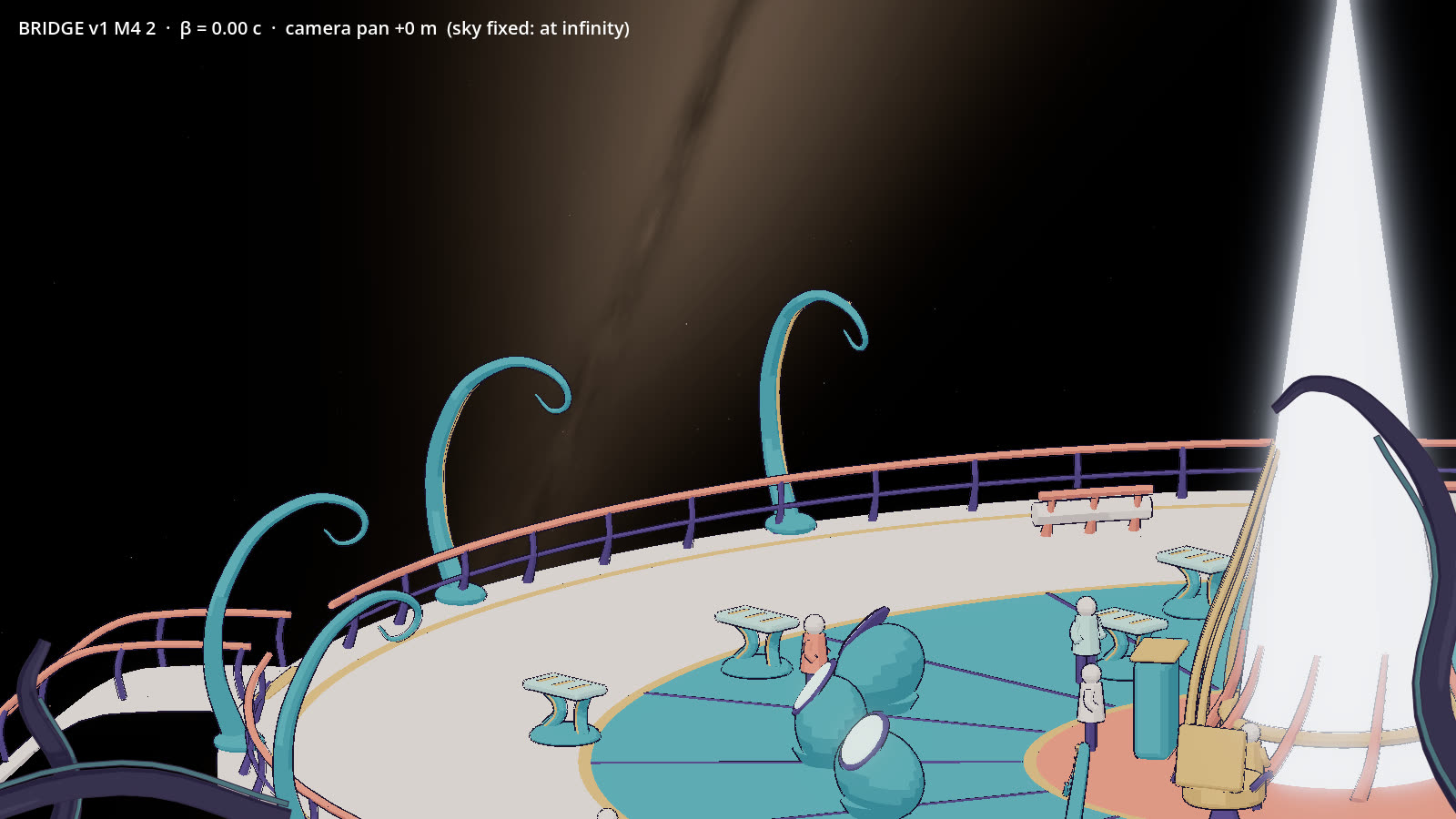
Ligne claire in the tradition of Moebius and Métal Hurlant: tiny people in vast, grown-looking spaces. The bridge sits at the top of the spire inside the sphere ship, and the sky behind its railings is never painted. It is the live relativistic sky, through the same camera.
A game you can learn relativity from, because it never cheats.
Every visual effect is held to a normative physics spec with numbered check values, asserted in tests before it merges. Named after Olaf Stapledon, author of Star Maker.
 Simulation built in AILANG