Decisions

Every ruling Mark has made on the game, in one place, so they can be reviewed, lived with and changed. Look, sound and words come first. Each card links to the line it came from.

Generated 2026-10-20 from the game repo's decision ledger, the design repo's design log (pinned at 42a99a7) and rulings recorded in sprint plans and art notes. 137 decisions. Story and narrative decisions are left out, so nothing here spoils the game.

How to change a decision

Any decision can be revised. Mark states a new ruling in an attended session, and it is recorded straight into the decision ledger (with mission_answer.sh), or he comments on the art issue #93 or the mission issue #1.

The page rebuilds its data from those records on every deploy. The design-repo log is refreshed when someone runs node scripts/decisions.mjs --sync in website/ and commits the new pin. The old ruling stays visible, marked superseded, with a link to the new one.

Revisit marks rulings that are explicitly provisional: demo art, a voice still to be auditioned, placeholder audio.

79 shown

D-96VisualInfrastructure

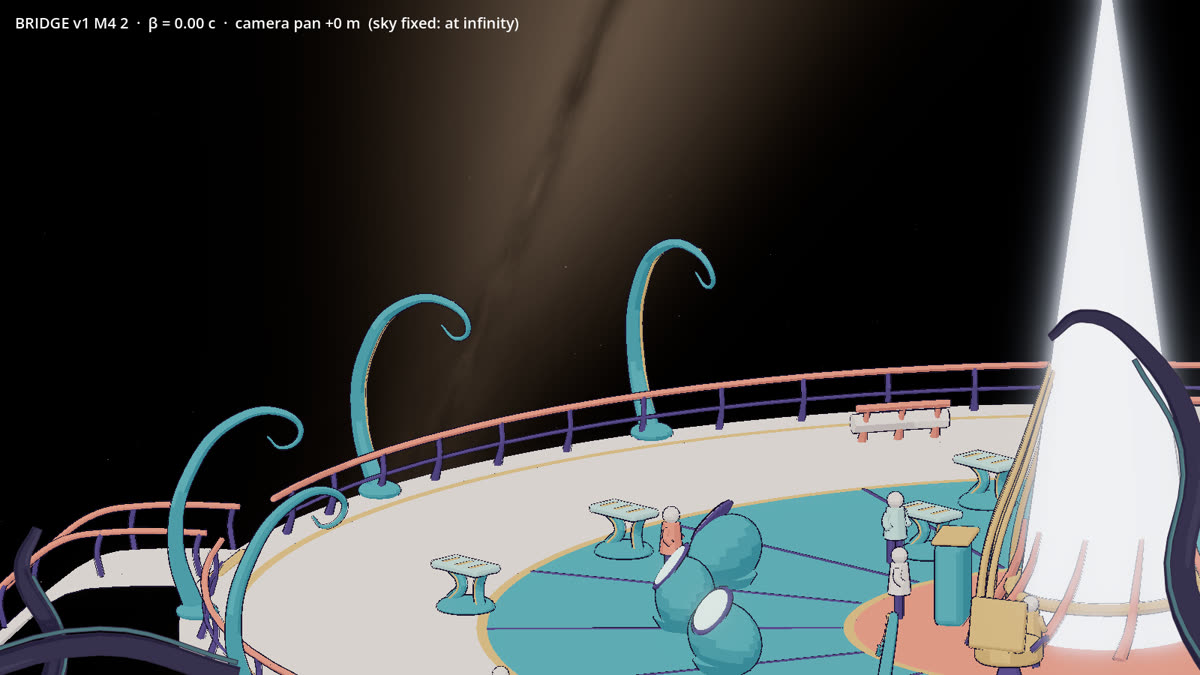
Bridge blockout accepted; the spire as the ship's own light

Question

R2-DECK-LAYOUT DL1 playtest (dev build v0.4.0-dev.34-home-tiers-60-g45c0c91d, PR #287, frames refs/deck_layout_bow/dl1/): accept the layout A blockout as built (Voyage and Crew desks 0.6 m bowward, chair keep-out 0.5 m) and carry on to DL2?

Ruling

ACCEPTED (Mark, attended 2026-10-20): "very nice". Direction for DL2 onward: (1) with fixed viewpoints, author eclipse and transition framings (a body passing the star, the starbow forming, arrivals) as set pieces; (2) light sources carry the atmosphere: the real star lights the bridge when one is close (R1-SHIP-STAR-LIGHT), and when nothing close by is available the spire is the bridge's own in-world light source, replacing the abstract ship-fixed broad key.

Provenance

PR #287 head cd2d0d74: rig/full green; deck-layout-eval, camera-test 187, camera-forward-test 22, make golden 393 ok.
D-94VisualInfrastructure

The Bow view accepted; ship art builds on it

Question

R2-CAMERA-FORWARD F1 playtest (dev build v0.4.0-dev.34-home-tiers-38-g0a787245, PR #282, review frames refs/camera_forward/f1/): accept the Bow view as built (extra occluder fades, captain ~81 px) and build ship assets against the Bow and Astern views?

Ruling

Accepted (Mark, attended 2026-10-20): "this looks great. we can do more ship building assets now assuming these". F1 Bow/Astern views are the basis for ship assets; finish F2-F3; re-plan R2-DECK-LAYOUT (D-90) and the Blender set dressing for the Bow view (spawn facing the lift goes to the deck plan).

Provenance

PR #282 (feat/camera-forward 0a787245): make test, camera tests and make golden green on the Studio; 8 review frames + walk contact sheet at gs://stapledons-voyage-assets/refs/camera_forward/f1/.

Design logVisualText

Travel Runs Along the Deck, Into the Screen

Context

R2-CAMERA-FORWARD (game PR #281) measured that with the forward pole straight overhead (D-14, "up = forward"), no camera can hold the deck and the journey in one frame. At the fixed 78° field of view the pole is in frame only at a pitch of 51° or more, and from there no deck is visible. Interior gravity is the generator's comfort 1 g (D-11, physics/higgs-bubble.md HB-6), not thrust, so nothing in the physics ties "up" to the direction of travel.

Ruling

- The direction of travel lies in the deck plane, toward the ship's bow. The decks stay level under the generator's 1 g, and the levels stack vertically along the generator mast (the spire), which is no longer a thrust axis. - The default bridge view looks over the captain toward the bow. The forward pole sits near the horizon above the deck, so the starbow, the destination and the bubble's forward glow share one frame with the deck and the crew. - It is a change of ship basis only, with no new physics formula.…Read the full ruling

- The direction of travel lies in the deck plane, toward the ship's bow. The decks stay level under the generator's 1 g, and the levels stack vertically along the generator mast (the spire), which is no longer a thrust axis. - The default bridge view looks over the captain toward the bow. The forward pole sits near the horizon above the deck, so the starbow, the destination and the bubble's forward glow share one frame with the deck and the crew. - It is a change of ship basis only, with no new physics formula. The physics frame keeps +Z = the direction of travel. Only its mapping onto the ship's structure (Blender +Y, the bow) changes. Goldens and forward-pole tests re-baseline to the new axis. - The Blender frame: +Z = up (the mast), and +Y = the bow (the direction of travel).

In Mark's words

shall we chaneg it so the direction of travel is the bubble moving sideways? > just for asethetic reasons? may make it all simpler? He then chose "Into the screen".

Rationale

Pillar 3 (Time Has Emotional Weight) and Pillar 5 (Grounded Strangeness): the journey ahead is on screen while the player walks, not one key away. Pillar 4 (The Ship Is Home): every open level's bow edge sees the forward sky, and its stern edge sees the sky go dark. The physics lesson now lives on every deck, not only at the bridge.

D-93VisualPlanets

Approve the forward camera plan

Question

Approve the R2-CAMERA-FORWARD plan (PR #281: design_docs/planned/r2/camera-forward.md + -sprint.md, sprint JSON awaiting_approval; design repo PR #30) and its open questions OQ1-OQ8.

Ruling

APPROVED (Mark, attended 2026-10-19): "yep looks great approved", with every recommendation: OQ1 Bow view candidate A (pitch -8 deg, 9 m back, 5.5 m up); OQ2 planet facing is the stop turn that brings the body into the Bow frame, a Target key later for free navigation; OQ3 Astern on key 9, no side view; OQ4 zoom levels Z1-Z3 removed for players, kept as developer presets, revisited after the dev build; OQ5 fade the spire, never turn the camera; OQ6 the Commons stays legacy; OQ7 inset Astern window later; OQ8 the painted-plate developer interior stays legacy this sprint. First pause point: a playable dev build after F1.

Provenance

Attended session 2026-10-19: bow candidates measured (gs://stapledons-voyage-assets/refs/camera_forward/bow_candidates/); independent Sonnet plan reviews 71, 76, 79 PASS.

D-92VisualPhysics

The ship travels along the deck, into the screen

Question

Ship orientation (amends D-14 "up = direction of travel throughout"): with D-91 fixed views, the forward pole straight overhead cannot share a frame with the deck (R2-CAMERA-FORWARD, PR #281, measured). Interior gravity is the generator's comfort 1 g, not thrust (D-11, physics/higgs-bubble.md HB-6), so travel may run along the deck. Change it, and which way does the default view see the travel?

Ruling

DECIDED (Mark, attended 2026-10-19): "shall we chaneg it so the direction of travel is the bubble moving sideways? just for asethetic reasons? may make it all simpler?" then chose travel into the screen. Amends D-14: the direction of travel lies in the deck plane, not up. Decks stay level under the generator's 1 g; the spire is the generator mast, not a thrust axis. The default bridge view looks over the captain toward the bow, the forward pole near the horizon above the deck, so the journey and the deck share one…Read the full ruling

DECIDED (Mark, attended 2026-10-19): "shall we chaneg it so the direction of travel is the bubble moving sideways? just for asethetic reasons? may make it all simpler?" then chose travel into the screen. Amends D-14: the direction of travel lies in the deck plane, not up. Decks stay level under the generator's 1 g; the spire is the generator mast, not a thrust axis. The default bridge view looks over the captain toward the bow, the forward pole near the horizon above the deck, so the journey and the deck share one frame; levels stack vertically. A change of ship basis only, no new physics formula; goldens and forward-pole tests re-baseline to the new axis. Design repo briefs (interior and exterior, ship-structure) are amended to match.

Provenance

Attended session 2026-10-19, PR #281 design review.

D-91VisualPlanets

One fixed forward camera that slides and never turns

Question

Camera model after the dev.33/dev.34 playtest (amends D-83 and R2-CAMERA, design_docs/implemented/r2/camera-fixed-views.md): the shipped camera swings to an authored yaw per sector (16 cells around the spire) as the captain walks, so the ship turns under the player, movement keys change screen direction, and the forward sky and the destination leave the frame. What should a fixed camera do as the captain walks?

Ruling

DECIDED (Mark, attended 2026-10-19): "we misunderstood what a fixed camera meant. as I walk around we can still see the whole ship, and I get a confusing new perspective where my buttons now dont travel to the right direction. I also now miss the good views of the onward forward facing jounrey and as I walk around lose the view of the planet/sun etc we are visiting. the fixed camera is meant to make it simpler by having fixed perspective and the player walks around in that." Then chose: slide, never turn. One…Read the full ruling

DECIDED (Mark, attended 2026-10-19): "we misunderstood what a fixed camera meant. as I walk around we can still see the whole ship, and I get a confusing new perspective where my buttons now dont travel to the right direction. I also now miss the good views of the onward forward facing jounrey and as I walk around lose the view of the planet/sun etc we are visiting. the fixed camera is meant to make it simpler by having fixed perspective and the player walks around in that." Then chose: slide, never turn. One fixed forward-facing perspective: the camera never rotates while walking, it glides to keep the captain in frame, the forward sky and the destination stay in view, and movement keys are screen-relative and constant. Zoom levels and the deliberate sky views stay. The sector swings go. Deck layout (D-90) is re-planned for the one forward view after this camera fix lands.

Provenance

Attended session 2026-10-19, Mark playing dev.34; R2-DECK-LAYOUT (D-90) paused at DL1 on feat/deck-layout (7863c831).

D-90VisualProcess

Rearrange the bridge for the fixed camera views

Question

Approve the R2-DECK-LAYOUT plan (PR #279: design_docs/planned/r2/deck-layout.md + -sprint.md, sprint JSON awaiting_approval) and its open questions OQ1-OQ8 (who models, style reference, captain chair as start and focal point, keep the spire needle, bridge and Commons scope, baked spire light, two layout candidates, Blender bpy scripts as authoring tools outside the game Python policy).

Ruling

APPROVED (Mark, attended 2026-10-19): "great please proceed - approved", with every recommendation: OQ1 an agent models through Blender bpy scripts, Mark may tweak; OQ2 the sprites' illustrated finish; OQ3 the captain chair is the start and focal point; OQ4 keep the spire needle and move props (fixed forward-view position as fallback); OQ5 bridge and Commons only; OQ6 bake the spire light; OQ7 two bridge layout candidates; OQ8 the Blender scripts live in ~/dev/blender as authoring tools outside the game's Python policy. Review points stay: Mark picks the layout after DL1/DL2 and approves the DL3 style frame.

Provenance

Attended session 2026-10-19: before contact sheet gs://stapledons-voyage-assets/refs/deck_layout/before/; pillar net +5; independent Sonnet plan review 74 then 86 PASS, 0 blocking.

D-85TextProcess

Approve the R2-SIMILAR-S0 sprint plan (row L9, semantic-memory S0 similar worlds

Question

Approve the R2-SIMILAR-S0 sprint plan (row L9, semantic-memory S0 similar worlds; PR #272: design_docs/planned/r2/semantic-memory-s0.md + -sprint.md, sprint JSON awaiting_approval). It deviates from L9 in two places: a top-level similar section in the new_game reply rather than system.similar (system membership changes with ship position), and emission from sim/protocol.ail with sim/core.ail untouched (protocol sessions already run strict). Which do you want? A — approve the plan as written; the loop executes S0.1–S0.3 (headless, no visible change) in later iterations. B — approve, but nest it as system.similar and/or re-export through sim/core.ail (say which); the loop amends the plan first. C — hold S0.

Ruling

DECIDED (Mark, attended 2026-10-19): A, approve the R2-SIMILAR-S0 plan as written (top-level similar section, emitted from sim/protocol.ail, sim/core.ail untouched); the loop executes S0.1-S0.3.

Provenance

Iteration 38 (loop, 2026-10-19): designer Opus wrote the doc (pillars net +7); quorum r1 BLOCKED (3 present), one revision, r2 BLOCKED 1 pass / 2 reject on missing verification rows, fixes applied under the narrow-refinement carve-out, gpt6-1-sol absent (unreachable) both rounds; plan by codex gpt-6.1-sol; independent Sonnet review 83/100 PASS, 0 blocking.

D-84VisualText

S1 render sign-off for M4.6rR3 (PR #265): the 3D-ship S1 set (7 states × deck an

Question

S1 render sign-off for M4.6rR3 (PR #265): the 3D-ship S1 set (7 states × deck and forward views, contact sheet) is public at https://storage.googleapis.com/stapledons-voyage-assets/refs/m4_ship_s1/contact_sheet.png. Physics gate 2 needs you to open it. Which do you want? A: signed off; the loop merges #265 after its CI is green (re-capturing first on the merged tree if attended #264 has landed, since #264 changes the scene the capture drives). The findings it shows go into the queue (flat white Earth and α Cen A discs, dust flashes at rest in the home frame, faded card ghosts, a hull spire in every forward view, cards over about 30 % of transit frames, no separate glow at 3.35e-5 W/m²). B: changes needed before sign-off (name which frames or views); the loop re-captures and asks again. AC12 (bench p99 < 16.7 ms) misses at HEAD in either case, and the parent plan (R3-8) puts it at P-land as row 7m.

Ruling

DECIDED (Mark, attended 2026-10-19): A, signed off. The loop merges #265 after its checks are green, re-capturing on the current tree first; the listed findings go into the queue as scene polish.

Provenance

Iteration 36 (loop, 2026-10-16): design design_docs/planned/r1/m4-6rr3-ship-renders-bench.md (pillar net +1); quorum PROCEED at 1 of 3 present; plan codex gpt-6.1-sol; executor codex gpt-6.1-sol (through an Agent-tool role), AC5 report design_docs/planned/r1/m4-6rr3-ship-renders-bench-report.md (15 frames opened); independent eval Sonnet 85 PASS, 0 blocking.

D-77VisualProcess

M4 AC4 says both clocks and the ISM readout show on every transit sample. On the

Question

M4 AC4 says both clocks and the ISM readout show on every transit sample. On the 3D ship, during braking, the Braking notice and the medium-boundary notice take both expanded card slots and fold the transit card (with its ISM readout) for about 2.8 s (42 of 716 samples). Which do you want? A — amend AC4: a folded transit card under those two named notices counts as shown (the ratchet already allows exactly this case, nothing else). B — keep AC4 literal: change the card priority so the transit card never folds in transit (a visible HUD change, attended).

Ruling

DECIDED (Mark, attended 2026-10-19): A. Amend AC4: a transit card folded under the Braking notice and the medium-boundary notice counts as shown; the ratchet keeps exactly that case pinned, nothing else.

Provenance

Iteration 29 (loop, 2026-10-14): make display-audit on the PR #232 scene run, display-audit known: transit-ISM 42, folding cards Cards/Card_medium_notice + Cards/Card_notice (Braking); entry in tests/fixtures/display_audit/known_findings.json; independent eval judged the exception tight (eval_R1-M4-JOURNEY_M4.5bR3_round_1.json).

D-83VisualProcess

R2-CAMERA zoom ruling (Mark, dev.31 playtest, 2026-10-16): "I think we need to t

Question

R2-CAMERA zoom ruling (Mark, dev.31 playtest, 2026-10-16): "I think we need to turn off zoom in and out for players, and switch to fixed zoom levels instead. we may want to also start having more fixed camera angles and not be 1st person but 3rd person only." Free player zoom and mouse look, or fixed levels and authored third-person views?

Ruling

DECIDED (Mark, attended 2026-10-16, "yes continue" on the camera plan with all nine recommendations; amended 2026-10-17): free player zoom and mouse look are removed; three fixed zoom levels (Z1 Close, Z2 Deck default at rest, Z3 Whole level); third person only (console focus stays a framed screen); no player camera rotation in R2; automatic situation cues that any input ends, prompts under reduced motion; no exterior view this sprint; perspective 78 deg; a developer free camera kept (F8 / --free-camera). Amendment 2026-10-17: "Sky forward under way" (under way Sky forward, at a guided stop Sky side, at Sgr A* the hole view; any zoom key returns to Z1-Z3). Supersedes D-63 for players.

In Mark's words

yes continue

Provenance

Attended, 2026-10-16. Design design_docs/implemented/r2/camera-fixed-views.md; plan PR #261; implementation PR #270 (evaluation 79/100 PASS).

Design logAudioText

One Trust Scale, Never Shown; the Game Raises Archive Events

Context

The Archive becomes a crew actor in the crew simulation (stapledons-godot archive-npc A1; crew_core 0.6). [archive-crew-trust.md](../features/future/archive-crew-trust.md) scores trust on −100..100, while the crew simulation scores all trust on 0..100 with 50 neutral.

Ruling

1. One scale for all trust: 0–100, 50 neutral. That covers crew to captain, crew to crew, crew to Archive and the Archive to crew. The archive-crew-trust table maps across by halving. 2. The numbers are not player-facing. They influence descriptions: the words on the crew console, the crew's lines, and the Archive's manner. 3. The game raises Archive events from what happens (answer confirmed or contradicted, crisis help or failure, confusion witnessed, captain backs it, repair, degraded). The crew simulation only…Read the full ruling

1. One scale for all trust: 0–100, 50 neutral. That covers crew to captain, crew to crew, crew to Archive and the Archive to crew. The archive-crew-trust table maps across by halving. 2. The numbers are not player-facing. They influence descriptions: the words on the crew console, the crew's lines, and the Archive's manner. 3. The game raises Archive events from what happens (answer confirmed or contradicted, crisis help or failure, confusion witnessed, captain backs it, repair, degraded). The crew simulation only applies their effects, by the table and each witness's personality, deterministically. 4. Earlier rulings for the first release (archive-npc OQ3 and OQ4): trust in the Archive only, with no captain coupling, and integrity changes only from events. Both are switches, off by default.

D-80VisualText

Crew names and faces (portraits trial #238; refines D-74): generated internation

Question

Crew names and faces (portraits trial #238; refines D-74): generated international names don't know the face they're paired with (the trial's analyst face is a woman named Santiago Navarro). Should names fit the face, faces be drawn to fit the name from per-role pools, or each featured face keep one canonical name?

Ruling

DECIDED (Mark, attended 2026-10-14): the name fits the face. Each featured portrait records a name region and gender, and the D-74 generator draws a name that fits that face: the same faces every game, varied names. People beyond the featured cast (successors, the population) get a face generated to fit their drawn name (D-7 generate on first use).

Provenance

Attended, 2026-10-14. Seen in renders/crew_console from the trial; D-74 draws names in sim/crew_names.ail from 14 regions with no face input.

D-79VisualText

Crew portraits (portraits trial #238): the game's crew include a Counselor, but

Question

Crew portraits (portraits trial #238): the game's crew include a Counselor, but the generation-cast plan and the Codex art handoff (stapledons-design art/handoff-codex-art.md) have no counselor identity; the trial shows the Diplomat's face. Which identity is the Counselor?

Ruling

DECIDED (Mark, attended 2026-10-14): the Diplomat is the Counselor. The game's counselor role takes the Diplomat identity (departure 62, embarks with an adult child and grandchild); its emotion-portrait set comes with the five departure identities in the Codex handoff part (b) step 2; no new counselor face.

Provenance

Attended, 2026-10-14. Raised by the portraits trial (PR #238): data/ai/cast/counselor.json has no portrait set; the handoff's part (b) emotion sets are keyed by cast identity.

Design logVisualPhysics

The Generator Is the Drive; One Closed Ledger of Resources

Ruling

1. Option B: the generator is the drive. The generator converts the bubble's interior mass directly into drive light, at 100% and with no waste heat, and does nothing else. This makes explicit a hand-wave the canon already assumed: no real fuel or radiator can supply the guided tour's ~3,100 kg of mass-energy. 2. The household runs on ordinary physics. That means fusion with a carried deuterium stock, and radiators limited by the wall's area. 3. m_eff = 1 kg. It is the inertia the pocket shows to the outside, not…Read the full ruling

1. Option B: the generator is the drive. The generator converts the bubble's interior mass directly into drive light, at 100% and with no waste heat, and does nothing else. This makes explicit a hand-wave the canon already assumed: no real fuel or radiator can supply the guided tour's ~3,100 kg of mass-energy. 2. The household runs on ordinary physics. That means fusion with a carried deuterium stock, and radiators limited by the wall's area. 3. m_eff = 1 kg. It is the inertia the pocket shows to the outside, not the ship's weight. Lowering it (towards 0.1 kg) is a candidate spire discovery. 4. Changing the wall's shape is a discovery, not a starting ability. A pointed bow cuts drag. 5. The energy options form the first basis of a discoverable tech tree: basking near stars, civilisation-beamed boosts, black-hole superradiance, hot-gas maps and efficiency blueprints. The tree "will evolve over time". 6. Atoms never grow; mass-energy can be topped up by incoming light. Every resource the crew use is one of eight: mass, water, power, heat, garden, fabrication, compute and signal.

Rationale

Grounded Strangeness, because one named hand-wave replaces a silent one. Choices Are Final, because every departure burns part of the ship. Ship Is Home, because the household loop is real and fragile.

D-74TextAI

Crew display names (R2-CREW C5; refines D-70 OQ2, which kept role ids and put di

Question

Crew display names (R2-CREW C5; refines D-70 OQ2, which kept role ids and put display names in the cast files): role names ("The Pilot") or personal names, and where do personal names come from?

Ruling

DECIDED (Mark, attended 2026-10-13): 'yeah we will name them, generated from a big list of international name combinations'. The featured crew get personal names, generated per new game from a large list of international given-name and family-name combinations. Role ids stay the internal entity_id (D-70 OQ2); the cast files keep the role name as the fallback.

Provenance

Attended. Raised in the R2-CREW C5 status (2026-10-13).

D-70TextPhysics

R2-CREW crew integration open questions (design_docs/planned/r2/crew-integration

Question

R2-CREW crew integration open questions (design_docs/planned/r2/crew-integration.md, PR #221): OQ1 crew turn length (ship-day or ship-week); OQ2 featured crew names; OQ3 first scenario aboard; OQ4 how the crew see the D-69 drive mass bill; OQ5 default captaincy and switching; OQ6 the ergosphere scenario heat imbalance (lab REVIEW).

Ruling

DECIDED (Mark, attended 2026-10-13): OQ1 one crew turn per ship-day; OQ2 role ids stay the entity_id, display names go in the cast files; OQ3 last-messages-home comes aboard first; OQ4 the drive mass bill is a ship event shown to the crew, readout only in R2; OQ5 consent by default, orders an explicit journalled choice at the Voyage console (adds a run-time policy command to crew_core CI-0); OQ6 the ergosphere scenario gets a third heat user before it comes aboard (lab authoring; not in the R2 slice). Folded into the design doc, merged as #221 (cd45aff).

Provenance

Attended. Raised in the crew integration design (PR #221, 2026-10-13).

D-69VisualPhysics

Bubble resources and the drive's energy (stapledons-design#20, features/next/bub

Question

Bubble resources and the drive's energy (stapledons-design#20, features/next/bubble-resources.md §4): the guided tour's interstellar legs cost ~3,100 kg of mass-energy, which no real fuel or radiator can supply, so the drive is already a second hand-wave. Options: A physics caps cruise near 0.9995c; B the generator turns interior mass into drive light; C total conversion for everything. Also: m_eff value, and may the wall's shape change?

Ruling

DECIDED (Mark, attended 2026-10-13): option B, 'assuming b) the generator is the drive'; 'm_eff as 1kg is fine'; 'being able to change the bubble shape is a good discovery'; the energy solutions (basking, civilisation-beamed boosts, black-hole superradiance, hot-gas maps, efficiency blueprints) 'are all good candidates for a tech tree we discover. this will evolve over time but this is a good first basis.' So: the generator converts interior mass to drive light at 100% and does nothing else; the household runs on…Read the full ruling

DECIDED (Mark, attended 2026-10-13): option B, 'assuming b) the generator is the drive'; 'm_eff as 1kg is fine'; 'being able to change the bubble shape is a good discovery'; the energy solutions (basking, civilisation-beamed boosts, black-hole superradiance, hot-gas maps, efficiency blueprints) 'are all good candidates for a tech tree we discover. this will evolve over time but this is a good first basis.' So: the generator converts interior mass to drive light at 100% and does nothing else; the household runs on ordinary fusion and radiators; m_eff = 1 kg (the guided drive's 10 kg is to be revisited when the ledger is enforced); a changeable wall shape (a pointed bow cutting drag) is a discoverable tech, not a starting ability; atoms never grow, while mass-energy can be topped up by incoming light. Constraint from Mark: there must be enough mass for a good game run (reach ~2,500 ly with 5 t free mass and 60 ship-years at 0.1 cm^-3).

Provenance

Attended. Raised in the bubble-resources design (stapledons-design#20, 2026-10-13).

D-67AudioVisual

In-world voice: may the Archive and the news from home say that something is inv

Question

In-world voice: may the Archive and the news from home say that something is invented, approximated or a game?

Ruling

DECIDED (Mark, attended 2026-10-12): 'lets make sure that the news in the archive terminal is in-game - e.g. it doesn't refer to itself as a hand-way physics stuff - it believes its real :)'. Everything shown at the Archive terminal (Archive entries, the news from home, the legacy line) speaks in-world: the ship believes the bubble is real and never calls anything invented, approximated, hand-waved or a game. This supersedes D-11's Archive rule 'the bubble is the one invented thing, and the entries say so'. What…Read the full ruling

DECIDED (Mark, attended 2026-10-12): 'lets make sure that the news in the archive terminal is in-game - e.g. it doesn't refer to itself as a hand-way physics stuff - it believes its real :)'. Everything shown at the Archive terminal (Archive entries, the news from home, the legacy line) speaks in-world: the ship believes the bubble is real and never calls anything invented, approximated, hand-waved or a game. This supersedes D-11's Archive rule 'the bubble is the one invented thing, and the entries say so'. What is invented or approximated is still recorded, out of world: in the physics spec (physics/higgs-bubble.md), the design docs, the credits and the HUD's labelled view modes. A test guards the in-world text against meta words.

Provenance

Attended.

D-66VisualProcess

Approve sprint-plan revision round 3 of R1-M4-JOURNEY (design_docs/planned/r1/m4

Question

Approve sprint-plan revision round 3 of R1-M4-JOURNEY (design_docs/planned/r1/m4-first-journey-sprint.md § Revision round 3; D-52 A / D-56 / D-57): M4.3b closed by absorption into R1-SHIP-UI; M4.5's scene half on the default 3D ship (plain launch → Board the ship → consoles; walking charged in the ≤360 s proxy); M4.6's gated half as ship goldens G-M4-S2/S3/S4, 3D-ship S1 captures and bench SCENE=bridge (iso-only G-M4-1 dropped for the ship); two attended hooks H1 (record seam in demos/ship_geometry_demo.gd, ~4 LOC) and H2 (news + legacy panels at the Archive terminal in demos/ship_consoles.gd, ~50 LOC); S1 render sign-off before the renders PR merges. Options: approve (H1/H2 attended, then the loop builds M4.5aR3 and M4.6gR3) / approve with changes / reject (the loop works triage L1–L8, R1, R2).

Ruling

APPROVED (Mark, attended 2026-10-12): sprint-plan revision round 3 of R1-M4-JOURNEY as recommended. H1 (record seam in demos/ship_geometry_demo.gd) and H2 (news and legacy panels at the Archive terminal in demos/ship_consoles.gd) are done attended first; then the loop builds M4.5aR3 and M4.6gR3 on the default 3D ship and parks for Mark's S1 render sign-off before the renders PR merges.

Provenance

Iteration 24 (2026-10-12): planner pi:ollama/kimi-k3:cloud; evaluations eval_R1-M4-JOURNEY_round3-plan_round_1.json (84, 1 blocking, fixed) and …round_2.json (90 PASS, 0 blocking).

Design logVisualText

Guided Voyage: Seven Real Highlight Legs

Context

Mark found the guided outer-system arrivals and their subsequent inward body legs repetitive and asked for a shorter tour of interesting views. The position audit found real 1,000-AU inward journeys of about 5.8 light-days, rather than a coordinate error. The existing D-54 finite-star planner can reach the close view in the interstellar leg itself.

Ruling

1. Start at Earth, then visit Sun → Jupiter → Callisto → Saturn → one close Alpha Centauri A → one TRAPPIST-1 → Aldebaran: seven travel legs. 2. Use the existing stop_rule = 54 finite-star arrival for the three interstellar destinations. Remove the duplicate 1,000-AU arrival and inward hop from the current guided tour. Preserve the historical stop_rule = 0 ten-leg itinerary for legacy replays and tests. 3. Keep the existing interstellar speeds, drive and hold/safety limits. Every leg starts from the preceding…Read the full ruling

1. Start at Earth, then visit Sun → Jupiter → Callisto → Saturn → one close Alpha Centauri A → one TRAPPIST-1 → Aldebaran: seven travel legs. 2. Use the existing stop_rule = 54 finite-star arrival for the three interstellar destinations. Remove the duplicate 1,000-AU arrival and inward hop from the current guided tour. Preserve the historical stop_rule = 0 ten-leg itinerary for legacy replays and tests. 3. Keep the existing interstellar speeds, drive and hold/safety limits. Every leg starts from the preceding actual endpoint; ship and Earth clocks stay continuous. Shorter presentation does not authorize position resets, teleports or invented distances. 4. TRAPPIST-1 uses its existing D-54 finite-star stop, without the former engineered habitable-zone placement beside planet e. Show and describe the actual planet positions and apparent sizes at that stop. 5. Offer Sgr A* after completion as an optional, clearly labelled separate GR demonstration. It is not an eighth continuous leg from Aldebaran.

Rationale

Grounded Strangeness keeps the views tied to real positions and the existing planner. Time Has Emotional Weight keeps the two clocks honest across the shorter itinerary. Choices Are Final keeps every travel leg a genuine checked commitment. Callisto remains both an interesting moon view and the clearance leg needed after the close Jupiter stop.

D-62VisualInfrastructure

D-61 follow-up: accept the R1-ISM-DUST P2 afterglow, sensitivity/default dust as

Question

D-61 follow-up: accept the R1-ISM-DUST P2 afterglow, sensitivity/default dust assumptions, per-medium glow and Archive drafts after the concrete dev-build and render review?

Ruling

ACCEPTED (Mark, attended 2026-10-10: 'Accept the current P2 choices'): retain the current afterglow, 0.5 m spot radius and 0.2 s decay, labelled a game approximation; accept the sensitivity/default dust assumptions (epsilon 1e-10, no disputed radar-meteor large-grain tail), per-medium glow, new lism-1 baselines and the Archive drafts. This completes the approved P2 checkpoint for PR A. The standing instruction is to merge into main after technical gates pass, then update gallery/news with recent features, including black-hole orbit and Saturn arrival videos. No performance or scientific criterion is waived; dense-cloud PR B remains deferred with failed comparisons.

In Mark's words

Accept the current P2 choices

Provenance

Attended 2026-10-10. Review build v0.4.0-dev.25-free-nav-64-gefadd459; named renders/HUD and replay hashes in data/ism/review-baselines.json; Archive drafts in stapledons-design PR #12.

D-61VisualText

Approve the ISM structure and dust-impact plan (PR #190, R1-ISM-DUST), the speed

Question

Approve the ISM structure and dust-impact plan (PR #190, R1-ISM-DUST), the speed-limit gameplay and the package publishes.

Ruling

APPROVED (Mark, attended 2026-10-09): sprint R1-ISM-DUST (PR #190, design_docs/planned/r1/ism-structure-and-dust.md) as drafted, with its defaults: grain flashes use the glow's epsilon = 1e-10; the wall afterglow shape is picked from a comparison sheet at review (labelled a game approximation); the disputed radar-meteor large-grain tail is left out; detours go via a star now, free-space waypoints later; Archive text drafts are reviewed at review; a guided-tour leg that fails the drive-hold check only has that…Read the full ruling

APPROVED (Mark, attended 2026-10-09): sprint R1-ISM-DUST (PR #190, design_docs/planned/r1/ism-structure-and-dust.md) as drafted, with its defaults: grain flashes use the glow's epsilon = 1e-10; the wall afterglow shape is picked from a comparison sheet at review (labelled a game approximation); the disputed radar-meteor large-grain tail is left out; detours go via a star now, free-space waypoints later; Archive text drafts are reviewed at review; a guided-tour leg that fails the drive-hold check only has that leg's speed lowered. The real medium is the DEFAULT for new games, and a planned route that exceeds the drive-hold limit through a dense cloud is REFUSED with the limit shown (e.g. the Leo Cold Cloud caps near 0.9987c), never silently capped (D-56). Standing go to publish the new package modules (sunholo/celestial ism, sunholo/relativity dust/medium additions) on the usual conditions: independent evaluation pass, clean ailang pkg quality, a clean dry run. Sequenced after the D-58 package releases; the HUD milestone waits for R1-SHIP-UI's strip and cards.

Provenance

Attended.

D-60VisualPhysics

Physically grounded bubble-wall effects at speed: real interstellar medium struc

Question

Physically grounded bubble-wall effects at speed: real interstellar medium structure and dust-grain impacts.

Ruling

DECIDED (Mark, attended 2026-10-09): 'yeah awesome lets do 1 - really communicate what space travel is and we get a visual representation of these densities - lets see the individual dust grain impacts as well'. (1) The interstellar medium along the route is real, patchy structure from cited maps (the Local Interstellar Cloud, the G-cloud, the Local Bubble, denser clouds from 3D dust/gas maps), driving the bubble-wall glow and the sim's existing ISM drag and wall load, with a visual representation of the densities…Read the full ruling

DECIDED (Mark, attended 2026-10-09): 'yeah awesome lets do 1 - really communicate what space travel is and we get a visual representation of these densities - lets see the individual dust grain impacts as well'. (1) The interstellar medium along the route is real, patchy structure from cited maps (the Local Interstellar Cloud, the G-cloud, the Local Bubble, denser clouds from 3D dust/gas maps), driving the bubble-wall glow and the sim's existing ISM drag and wall load, with a visual representation of the densities (in flight, e.g. the HUD naming the medium, and on the map); route choice through or around clouds becomes a strategic, no-twitch decision (D-56). (2) Individual dust-grain impacts on the wall, drawn from a cited grain size distribution (MRN-like) and the local dust density: rare bright flashes over the forward dome, more in dusty clouds, energies from the package. Stays within D-59's white, atmospheric look; no magnetic shaping (not physical at these energies); a wall afterglow, if used, is labelled a game approximation. Physics maths in the packages first; design doc and sprint plan for Mark's approval before execution.

Provenance

Attended.

D-57VisualInfrastructure

Approve the ship UI plan (PR #181, R1-SHIP-UI) and decide how it fits the loop's

Question

Approve the ship UI plan (PR #181, R1-SHIP-UI) and decide how it fits the loop's M4.3b.

Ruling

APPROVED (Mark, attended 2026-10-09): sprint R1-SHIP-UI (PR #181, design_docs/planned/r1/ship-ui-hud-consoles.md) as drafted, with its defaults: M is an instant read-only star chart (plotting and commit only at the navigation station); tour pause, skip stage and skip dwell stay instant; the station layout (navigation station console_navigation_0..2, voyage console console_decision_0, Archive terminal at the spire; console_decision_1..3 reserved for M6 crew decisions); accessibility (press-twice confirm,…Read the full ruling

APPROVED (Mark, attended 2026-10-09): sprint R1-SHIP-UI (PR #181, design_docs/planned/r1/ship-ui-hud-consoles.md) as drafted, with its defaults: M is an instant read-only star chart (plotting and commit only at the navigation station); tour pause, skip stage and skip dwell stay instant; the station layout (navigation station console_navigation_0..2, voyage console console_decision_0, Archive terminal at the spire; console_decision_1..3 reserved for M6 crew decisions); accessibility (press-twice confirm, click-to-walk, a keyboard Walk-to list). The plan ABSORBS M4.3b's 3D-ship half (its transit card, U2): the loop does not build M4.3b; M4.3b's 'shortcuts M, L and K' and M4.5's 'bot through Godot's input layer' are revised to D-56 (M read-only, decisions at consoles; M4.5's bot works the consoles). Console use: the camera dollies to a framed, readable panel (Esc steps back), not fully in-world screens. Executed attended after the free-navigation PRs (#171, #182) merge.

Provenance

Attended.

D-51VisualProcess

Starmap single truth: which position wins when catalogues disagree (precedence r

Question

Starmap single truth: which position wins when catalogues disagree (precedence rule truth-1, PR #145).

Ruling

DECIDED (Mark, attended 2026-10-07): 'yes trust cns5s I guess i dunno not really qualified' - accepted the recommendation, not an expert judgement. Rule truth-1: where CNS5 judged a star (including its 69 choices of Hipparcos or DR2 over a poor EDR3 solution, RUWE >= 1.68), its parallax stands; Gaia is used for stars CNS5 never matched. Navigation moves for one star (CNS5:138). Revisit if a better rule or Gaia DR4 changes the audit.

Provenance

Attended.

D-49VisualProcess

Star colour in Auto view, and the final approach to a giant star (dev.19 review)

Question

Star colour in Auto view, and the final approach to a giant star (dev.19 review).

Ruling

DECIDED (Mark, attended 2026-10-07): 'lets have auto mode dim enough to have pretty star colours, and yes lets make a longer approach for bigger stars - these are all good gameplay touches'. Auto view dims a star's disc to just above lit bodies and lifts its own blackbody chroma (labelled on the HUD); Realistic is untouched. A giant's final approach lasts 90 s from where it is 25 deg across.

Provenance

Attended.

D-48VisualPhysics

The bubble-wall glow at high in-system speed, and go-ahead for finite destinatio

Question

The bubble-wall glow at high in-system speed, and go-ahead for finite destination stars.

Ruling

DECIDED (Mark, attended 2026-10-07): keep the glow as modelled ('the glow is great - it helps show how it is'); no Auto-view fading of it. Go ahead with the finite destination stars now ('yes please fix the stars now').

Provenance

Attended quotes above.

D-52VisualText

Which ship scene does R1's first journey (bar clause 4) run in? The approved M4

Question

Which ship scene does R1's first journey (bar clause 4) run in? The approved M4 plan (D-22) builds Track B on the isometric --interior composite (D-6): M4.3b moves the journey HUD and transit into it, and M4.5's playthrough audit and M4.6's gated goldens and S1 renders run there. Since the unified painted ship (attended 2026-10-05) the default launch opens the 3D painted ship, which already shows live boost, cruise and braking, and --interior is a developer reference mode. Options: (A) the unified 3D ship: re-plan M4.3b, M4.5 and M4.6's gated half against it, and stop building journey work into --interior; (B) keep the plan: build M4.3b into --interior and run M4.5 and S1 there, so clause 4 is proven in a scene players don't see by default; (C) split: M4.5's audit runs in whatever the default launch opens, and --interior keeps only its existing smoke test.

Ruling

DECIDED (Mark, attended 2026-10-08): A, the unified 3D painted ship. Re-plan M4.3b, M4.5 and M4.6's gated half against the default 3D ship; stop building journey work into --interior, which stays a developer reference mode with its existing smoke test.

Provenance

Loop iteration 20 (2026-10-07), Gate 2 reality check: design_docs/planned/r1/m4-unified-painted-ship.md § Approved continuation (one normal entry; --interior kept as a developer reference mode); the M4.3b, M4.5 and M4.6 rows in .ailang/state/sprints/sprint_R1-M4-JOURNEY.json; D-6.

D-36VisualProcess

Ship geometry demo scope and camera consistency.

Question

Ship geometry demo scope and camera consistency.

Ruling

APPROVED (Mark, attended 2026-10-04): bridge overlook and one-tier lift demo, with one meaningful perspective shared by stars, existing SR, play area and background geometry; future GR must use that same viewpoint.

Provenance

Approved design/sprint: design_docs/planned/r1/m4-ship-geometry-demo.md; isolated demo/ship-geometry-seven implementation branch.

D-35VisualPhysics

Boundary clearance in the selected seven-layer geometry reference.

Question

Boundary clearance in the selected seven-layer geometry reference.

Ruling

DECIDED (Mark, attended 2026-10-04): retain the proposed 5 m minimum clearance.

Provenance

Attended ship-geometry review; art/ship-dimensions-v2/layout.json and website/docs/ship-layer-reference.mdx.

D-34VisualPhysics

Bubble-ship major tier count for the geometry/art study.

Question

Bubble-ship major tier count for the geometry/art study.

Ruling

DECIDED (Mark, attended 2026-10-04): seven major layers are chosen; remove the twenty-deck option from the review; architecture within those layers will include buildings, forests and other spaces.

Provenance

Attended ship-geometry review; art/ship-dimensions-v2 and website/docs/ship-layer-reference.mdx.

Recorded rulingAudioVoice format Revisit

Voice files: Ogg canonical, WAV playback copy

Revisit: The voice heard today is a stub placeholder, not a real voice.

Question

Godot 4.7 cannot play Ogg Opus; keep a WAV copy beside each voice blob?

Ruling

Mark's rulings (attended 2026-10-03): keep the WAV playback copy, the Ogg canonical, with the WAV verified to re-encode to the Ogg (make ai-playback-verify, in make test).

Provenance

Attended ruling during the AI.10a Medic style frame, recorded in the sprint plan.

  • Refines: D-7 (not shown here)
Placeholder
Placeholder: the stub voice is a steady test tone, not a voice.
Recorded rulingAudioVisualVoice and portraits Revisit

Portrait swaps 150 ms early, 120 ms crossfade

Revisit: Tuned on the stub voice; recheck with the real voice.

Question

When should the portrait swap relative to the voice segment, and how long is the crossfade?

Ruling

Mark's rulings (attended 2026-10-03): swap timing 150 ms early, so swap_offset_ms defaults to -150 with the 120 ms crossfade (tests and capture updated; the rehearsal log does not carry the offset and is unchanged).

Provenance

Attended ruling during the AI.10a Medic style frame, recorded in the sprint plan.

  • Refines: D-7 (not shown here)
The Medic rehearsal: portraits swap 150 ms ahead of each segment with a 120 ms crossfade (stub voice).
Recorded rulingVisualCharacters

The captain: proposal A, the Longline Navigator

Question

Which of the three captain silhouette proposals becomes the captain?

Ruling

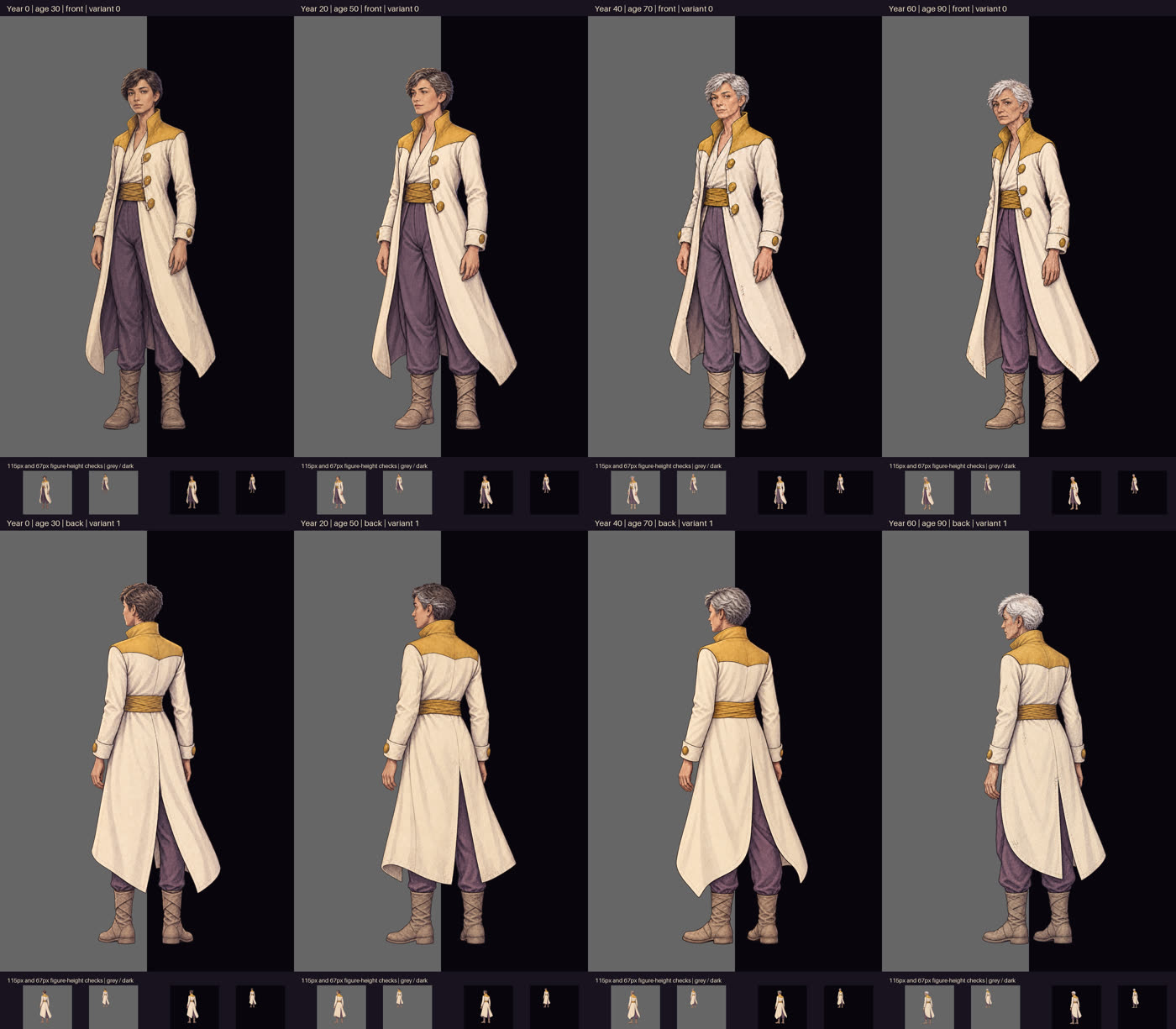
Mark picked proposal A in the attended task on 2026-10-03. The eight final views preserve that identity, costume language and cream/ochre/violet palette. Final set status is proposed for visual review; the identity choice is picked. AI-generated (gpt-6.1-sol); no copyright claimed (D-33).

Provenance

Recorded in the captain set's generation notes (game PR #98); the eight final views are proposed for visual review, the identity choice is picked.

The Longline Navigator at 30, 50, 70 and 90, front and back (game PR #98).
Design logVisualPhysics

Forward Glow: Faint at Cruise, a Cue at the Top, With a Blackbody Spectrum (ledger D-29 and its follow-up, D-30)

Context

The M4.2 evaluation found the bubble-wall glow pole at 0.99c 130× brighter than the 23.5 mag/arcsec² dark sky, using the canon ε = 10⁻⁹ and a placeholder equal-energy white spectrum (182.6 lm/W). At that level it drowns the starfield, which contradicts "faint by design". physics/higgs-bubble.md gave no spectrum.

Ruling

1. D-29: lower the wall conversion efficiency ε to about 10⁻¹¹, so the forward glow is faint and the starbow stays visible. 2. D-30: the glow is a hot-plasma blackbody whose temperature comes from the impact energy. It is computed in sunholo/relativity (0.8.0) first and replaces the equal-energy white. 3. D-29 follow-up (same session): "the glow can be any value right? but I want our star effects to be seen, so just pick a value where we get both." Canon ε = 10⁻¹⁰ (HB-111). It was chosen from a rendered comparison…Read the full ruling

1. D-29: lower the wall conversion efficiency ε to about 10⁻¹¹, so the forward glow is faint and the starbow stays visible. 2. D-30: the glow is a hot-plasma blackbody whose temperature comes from the impact energy. It is computed in sunholo/relativity (0.8.0) first and replaces the equal-energy white. 3. D-29 follow-up (same session): "the glow can be any value right? but I want our star effects to be seen, so just pick a value where we get both." Canon ε = 10⁻¹⁰ (HB-111). It was chosen from a rendered comparison of 10⁻¹¹, 3 × 10⁻¹¹, 10⁻¹⁰ and 3 × 10⁻¹⁰ through the game's eye exposure at five speeds. The sheet is stapledons-godot make glow-eps-sheet, published at gs://stapledons-voyage-assets/refs/glow/eps_compare.jpg.

Rationale

- Pillar 5 (Grounded Strangeness): the colour follows the physics of the impacts, red at the default cruise and blue-white at the top. Only one admitted hand-wave remains, the bubble. - Pillar 3 (Time Has Emotional Weight): the starbow, the signature view of relativistic travel, stays readable at every speed. - The glow is a motion cue from about 0.997c up. It appears as the player pushes into the costly end of the slider, and fades as the ship brakes.

Design logVisualText

Bridge v2: Illustrated Plate, Spire Light, 8K, and Levels That Follow the Sphere

Context

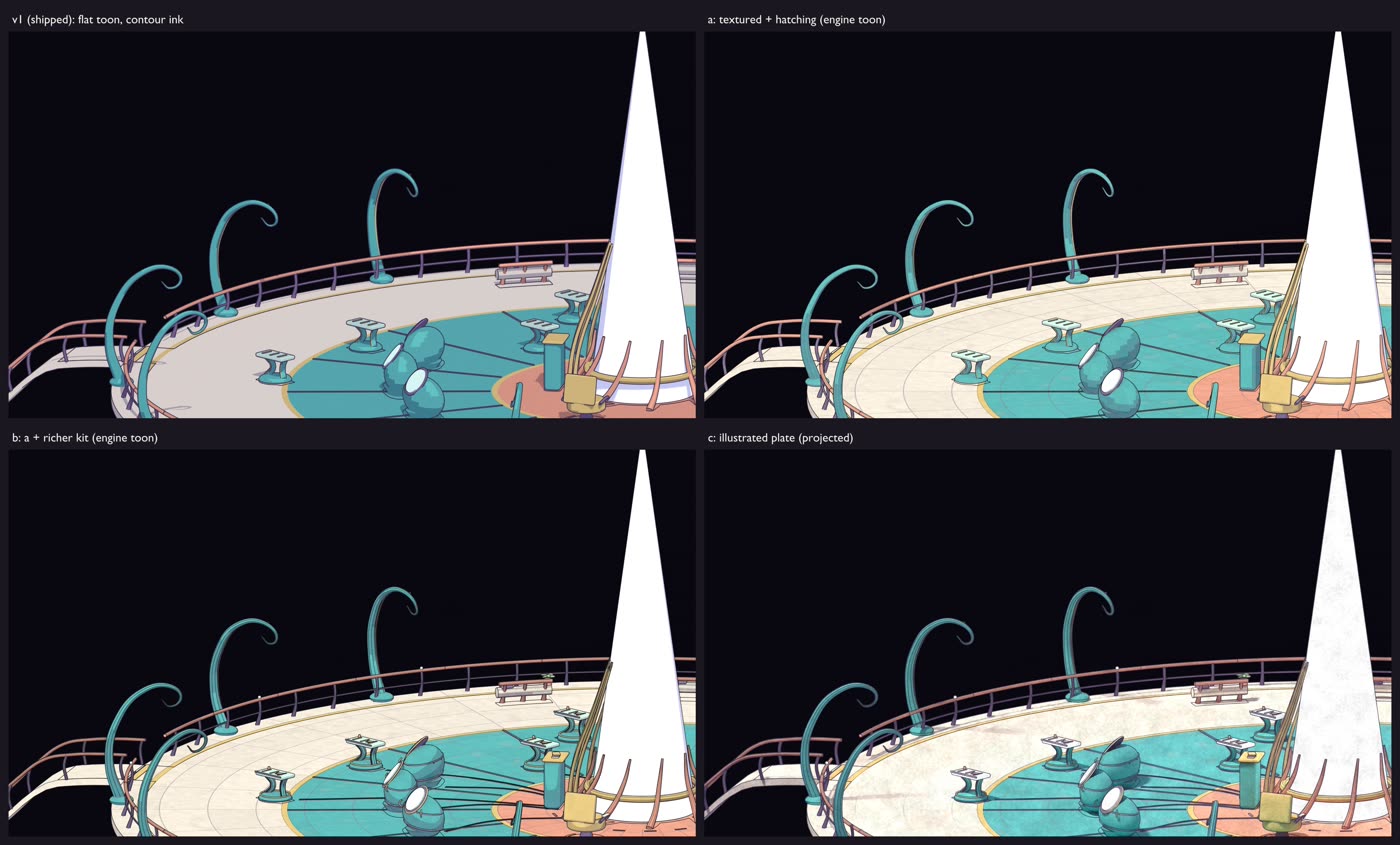
Mark approved bridge v1 (game PR #97) for the playable demo, and asked for a final bridge as good as the captain avatar sprites (game PR #98). The Blender thread's quality study (game issue #93) compared: - (a) a textured toon GLB; - (b) (a) plus a richer kit; - (c) an illustrated plate projected through the fixed iso camera onto the play GLB, with a Godot capture of (c).

Ruling

1. Approach c, plus a Codex image-model refine pass to reach the captain sprites' hand-illustrated finish. 2. Baked static light and shadow of ship geometry are allowed in the plate. - The spire is the dominant, ship-fixed light source, so it is baked as the key light with its shadows; that is what makes baking valid. - Nothing from outside the ship is baked. The forward bubble-wall glow (relativity 0.6.0 glowEmittanceAt, ship.ism.glow_pole_w_m2) and the relativistic sky vary with speed and direction, so they…Read the full ruling

1. Approach c, plus a Codex image-model refine pass to reach the captain sprites' hand-illustrated finish. 2. Baked static light and shadow of ship geometry are allowed in the plate. - The spire is the dominant, ship-fixed light source, so it is baked as the key light with its shadows; that is what makes baking valid. - Nothing from outside the ship is baked. The forward bubble-wall glow (relativity 0.6.0 glowEmittanceAt, ship.ism.glow_pole_w_m2) and the relativistic sky vary with speed and direction, so they become a thin live layer: a directional tint and rim term on the iso layer, driven by the sim's glow value and the forward sky brightness (emittance → radiance /π for a Lambertian wall, M4.6a eval N3). - Plates keep headroom in the highlights and ship a forward-facing hint. - Characters are never baked, and space stays alpha 0. 3. 8K plate density (270 px/m), a 64 MB per-area bucket budget, and the palette pulled toward the captain sheet's cream, ochre and violet. 4. More ship structure in the panorama: - It should read as the top of the sphere's interior: the spire running down, and the lower, larger levels below the bridge rim. - Space stays mostly visible. 5. Game-side work (Claude): - the layers.play.plate manifest key; - the projection shader in the M4.2 composite; - a linear or compensated tonemap on the iso layer; - the live glow term; - plate checks in validate-areas. 6. Ship scale (canon): the bridge is the topmost and smallest level. - Levels follow the sphere: they widen down to the equator and shrink again past it (radius ∝ R · sin θ; the spike's 55% of the bubble's cross-section). - Lower levels (future areas) are much larger, so the kit and textures are built to scale up: modular pieces, texel-density-based textures, and plates tiled per area when needed.

Rationale

Pillar 4 (The Ship Is Home): the bridge has to look as hand-made as its people. Pillar 5 (Grounded Strangeness): only the spire's fixed light is baked, so everything that depends on speed stays physically live.

Design logVisualPhysics

Bridge v2 Follow-up: Forward Sky First; Levels Are Future-Area Guidance

Context

The Blender thread built bridge v2 with a look-down panorama showing the lower levels (ruling 4 above). That framing hid the starbow at 0.99c, and only a rim of the level below showed above the bridge's far rail.

Ruling

1. Keep the starbow. The bridge panorama prioritises the forward sky: it keeps v1's up-looking camera, painted with the v2 look. This supersedes ruling 4 of the bridge v2 entry above. 2. The bridge was never meant to show the lower levels, and its perspective can't. The sphere-scaled levels (ruling 6 above) are guidance for future areas, as later generations move down the ship: - each lower level is wider down to the equator, then narrower again; - each lower level is roofed by the underside of the level above. 3. Keep the moody spire-only lighting as built. 4. Ship both facing hints. 5. The palette shift is accepted.

Design logVisualProcess Revisit

Art Handoffs for M4.2: Finish Bridge v1; Captain Sprite and Cast Portraits

Revisit: The filled-in details are proposals Mark can change on the PRs.

Context

Two new art threads start: a Blender thread (a Claude Opus agent) and a 2D art thread (Codex "Sol 6.1" agents, which have no Claude tooling). A read-only audit found bridge build-out v1 unmerged in the Blender repo, and conflicting character specs (2048 vs 1254 px, the age grid, filename patterns, Medic v2 vs cast_marker_v1).

Ruling

1. Blender: finish bridge v1 for M4.2. Bridge only in R1. - Merge art/bridge-buildout-v1 to the Blender repo's main, as a PR. - Add parallax overscan to the panorama and foreground plates. - Export the iso play camera: orthographic, pitch −14°, yaw 45°, iso size 16 m, as in M4.2's manifest. - Define WALK_ navmesh rules: flat, a maximum slope, rim gaps and an obstacle convention. - Add a 1.75 m scale figure and a 2 m grid to the area template, for review only. - Pass the Blender-side validator now, and M4.0's Godot…Read the full ruling

1. Blender: finish bridge v1 for M4.2. Bridge only in R1. - Merge art/bridge-buildout-v1 to the Blender repo's main, as a PR. - Add parallax overscan to the panorama and foreground plates. - Export the iso play camera: orthographic, pitch −14°, yaw 45°, iso size 16 m, as in M4.2's manifest. - Define WALK_ navmesh rules: flat, a maximum slope, rim gaps and an obstacle convention. - Add a 1.75 m scale figure and a 2 m grid to the area template, for review only. - Pass the Blender-side validator now, and M4.0's Godot make validate-areas BUNDLE=... once M4.0 lands. 2. Art (Sol), both, in order: - (a) the captain avatar: the walking captain sprite for the iso bridge at 4 life stages, with the foot anchor matched to the iso camera and the canvas spec defined; - (b) then full-cast emotion-portrait sets like the Medic's, for later AI dialogue. 3. Delivery for both threads: - A PR to the game repo sunholo-data/stapledons-godot: into assets/areas/<area>/ for bundles, and the agreed character asset path for characters. - Large binaries go to the public bucket gs://stapledons-voyage-assets/ (content-addressed <sha256>.<ext>), referenced by pins. - A Codex agent can't run gcloud, so it includes the files in its PR branch; the Claude side moves large files to the bucket. - Review happens on the PR, with renders attached. 4. Portraits: - The generator's native resolution (about 1254 px), never upscaled. - Each set gets a generation_notes.md recording the generator, model, full prompt, date and seed (if any). - Project art is owned by Sunholo and shipped with the Apache-2.0 codebase. - Third-party references must not be traced or copied.

Design logVisualAudio

Art Handoff Follow-ups: Medic v2 Stays; Captain Stages; Art Channel

Context

Mark answered the open questions on the 2026-10-03 art handoffs (design-repo PR #4).

Ruling

1. Medic v2 stays the Medic's identity and the format reference for every portrait set (pinned in the game repo's data/ai/core). This clarifies D-16: "superseded" closed the Medic-only review stage; it did not retire the Medic. 2. The captain sprite, as proposed: stages 0/20/40/60 years since departure (ages 30/50/70/90 at the default start age), front and back three-quarter facings, a static sprite with no walk cycle. 3. Codex access: the reference images are public at…Read the full ruling

1. Medic v2 stays the Medic's identity and the format reference for every portrait set (pinned in the game repo's data/ai/core). This clarifies D-16: "superseded" closed the Medic-only review stage; it did not retire the Medic. 2. The captain sprite, as proposed: stages 0/20/40/60 years since departure (ages 30/50/70/90 at the default start age), front and back three-quarter facings, a static sprite with no walk cycle. 3. Codex access: the reference images are public at https://storage.googleapis.com/stapledons-voyage-assets/refs/characters_v1/, with a SHA256SUMS. The set is the ten cast_marker_v1 portraits and the Medic v2 set. 4. Art channel: game-repo issue #93 replaces issue #1 for art questions and PR links. 5. Confirmed: - the bucket prefix areas/; - isocam_<area>.json; - the character path assets/characters/<entity_id>/; - bridge bundle PRs based on main. 6. Pan range: overscan is sized for [6, 3] m, and parallax is clamped beyond it. 7. Game-side work is Claude-side: - the areas/ blob fetch target; - clamped parallax; - the importer from assets/characters/ into data/ai/core.

The captain sprite as ruled: stages 0/20/40/60 years since departure.
D-33VisualAI

Licensing of our own AI-generated work: the captain and bridge art and generatio

Question

Licensing of our own AI-generated work: the captain and bridge art and generation notes say 'owned by Sunholo, Apache-2.0', but purely AI-generated output may not be copyrightable. Scope?

Ruling

DECIDED (Mark, attended 2026-10-03): art only, no claim: remove ownership/Apache claims from AI-generated art (captain, bridge, concept art) and label it AI-generated, no copyright claimed; the code keeps Apache-2.0; third-party CC BY credits stay

Provenance

assets/characters/captain/*, refs/bridge_v2 BRIEF, website/docs/credits.md, README.

D-30VisualPhysics

Forward glow spectrum: higgs-bubble.md does not define the colour of the wall gl

Question

Forward glow spectrum: higgs-bubble.md does not define the colour of the wall glow (placeholder equal-energy white, 182.6 lm/W). Options: hot-plasma blackbody from the impact energy / neutral white / hydrogen recombination lines.

Ruling

DECIDED (Mark, attended 2026-10-03): the glow spectrum is a hot-plasma blackbody whose temperature is derived from the impact energy, computed in sunholo/relativity first (package-first), replacing the equal-energy white placeholder.

Provenance

M4.2 PR #102; interior/forward_glow.gd.

D-29VisualText

Forward glow strength (M4.2 evaluation): at the canon ε = 1e-9 the bubble-wall g

Question

Forward glow strength (M4.2 evaluation): at the canon ε = 1e-9 the bubble-wall glow pole is 130× the 23.5 mag/arcsec² dark sky at 0.99c and drowns the starfield, contradicting "faint by design". Options: lower ε (~1e-11) / keep and fix the text / tie to the glazing follow-up.

Ruling

DECIDED (Mark, attended 2026-10-03): lower the canon wall conversion efficiency to about 1e-11 so the forward glow is faint and the starbow stays visible (design-repo canon change: higgs-bubble.md eps and dependent HB rows, the package check values and the sim).

Provenance

Merge approval (Mark, attended 2026-10-05): "can we merge in all the PRs and branches now?" authorizes landing the current PR #113 proposal, ε = 1e-10 with its checked spectral implementation and controlled replay re-freeze, together with the linked canon update. eval_R1-M4-JOURNEY-M4.2_round_1.json; test_physics.gd:885; m4-first-journey.md:362.

D-28VisualPhysics

M1 sky mirror (M4.2 evaluation, confirmed four ways): Starfield.galactic_to_worl

Question

M1 sky mirror (M4.2 evaluation, confirmed four ways): Starfield.galactic_to_world is a reflection (det −1), so the whole M1 sky (stars, panorama, sky model, CMB) renders as a mirror image of the real sky; GPU-vs-CPU goldens could not see it because both sides share the map. M4.2 corrects it locally. Fix at the source now or later?

Ruling

DECIDED (Mark, attended 2026-10-03): fix the mirror at the source now in a dedicated PR: one right-handed rotation map used everywhere (the seven copies removed), the interior's local flip dropped, and every reference render regenerated and reviewed.

Provenance

eval_R1-M4-JOURNEY-M4.2_round_1.json; sky/starfield.gd:31.

D-27VisualPhysicsCMB glare

Forward CMB glare and auto-dimming glazing

Question

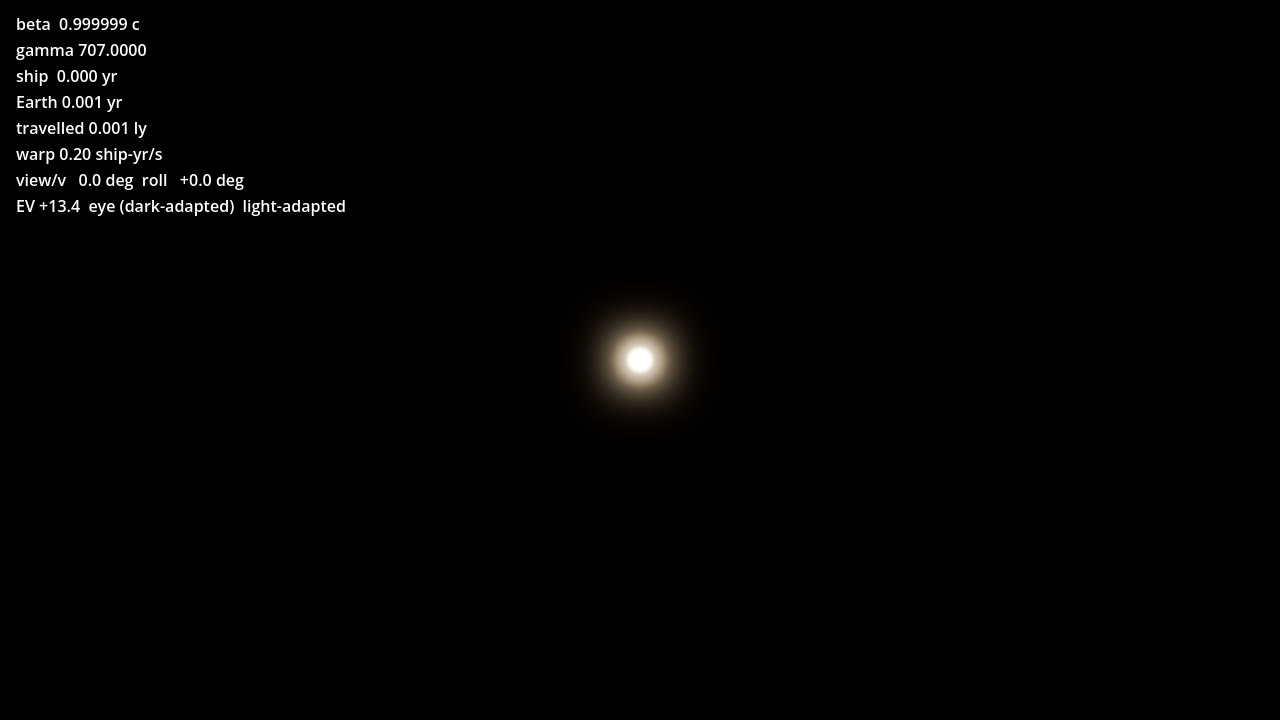
Forward CMB glare (M1.8 evaluation P1): at γ 707 the forward disc is ~2e8 cd/m² (an eighth of the solar disc) and the model adapts the eye and draws a clean dot with no glare, saturation or afterimage. Options: glare/saturation plus auto-dimming labelled glazing / HUD warning only / leave it.

Ruling

DECIDED (Mark, attended 2026-10-03): physically motivated glare/saturation around the forward disc plus auto-dimming labelled glazing, as a follow-up milestone (queue row 6b); M1.8 merges as is. R-e approved.

Provenance

eval_R1-M1-SKY-2-M1.8_round_1.json; sky/sky_meter.gd, sky/exposure.gd.

The forward CMB at γ 707 today: a clean disc, no glare yet.
D-26PlanetsVisual

A new milestone: planets and flybys (M5)

Question

Planet renders (Saturn, solar-system flybys, as in the retired Go build) are on no roadmap; the design repo only has Go-era feature docs (future/planet-rendering-polish, planetary-rings, planet-state-transitions, ailang-planet-ring-moon-data). Options: a new R1 milestone M5 / fold into M4 arrival / R2.

Ruling

DECIDED (Mark, attended 2026-10-03): a new R1 milestone M5 'Planets and flybys' (queue row 6c): AILANG-driven solar-system data, Godot planet rendering with rings and relativistic flyby views, Sol's planets plus the α Cen arrival scene; design doc first.

Provenance

stapledons-design/features/future/*planet*; legacy/go-engine-features/ailang-solar-system-demo.md.

D-25VisualPhysicsExposure

Exposure anchors: Milky Way 20.8, deep space 23.5 mag/arcsec²

Question

M1.5a exposure anchors flagged by the M1.5a evaluation: the Milky Way brightness anchor for the un-stretched NOIRLab panorama (executor used an uncited 20 mag/arcsec²), and the dark-sky surface brightness (22 mag/arcsec² is a ground-site value with airglow and zodiacal light; interstellar space is about 23.5–24).

Ruling

DECIDED (Mark, attended 2026-10-03): Milky Way anchor 20.8 mag/arcsec² cited to Leinert et al. 1998 (A&AS 127, 1, Table 16) and Duriscoe 2013 (PASP 125, 1370), replacing the uncited 20, with a Gaia/Tycho integrated-flux calibration as a later M1 item; dark sky moves to the deep-space value (~23.5 mag/arcsec², integrated starlight + diffuse galactic light + EBL, no airglow or zodiacal light) in M1.5a itself, with the AC8 naked-eye window moving accordingly (~6.9); R-d approved on the look (eye default, camera labelled).

Provenance

eval_R1-M1-SKY-2-M1.5a_round_1.json; sky/background.gd MILKY_WAY_MAG; sky/exposure.gd DARK_SKY_MAG.

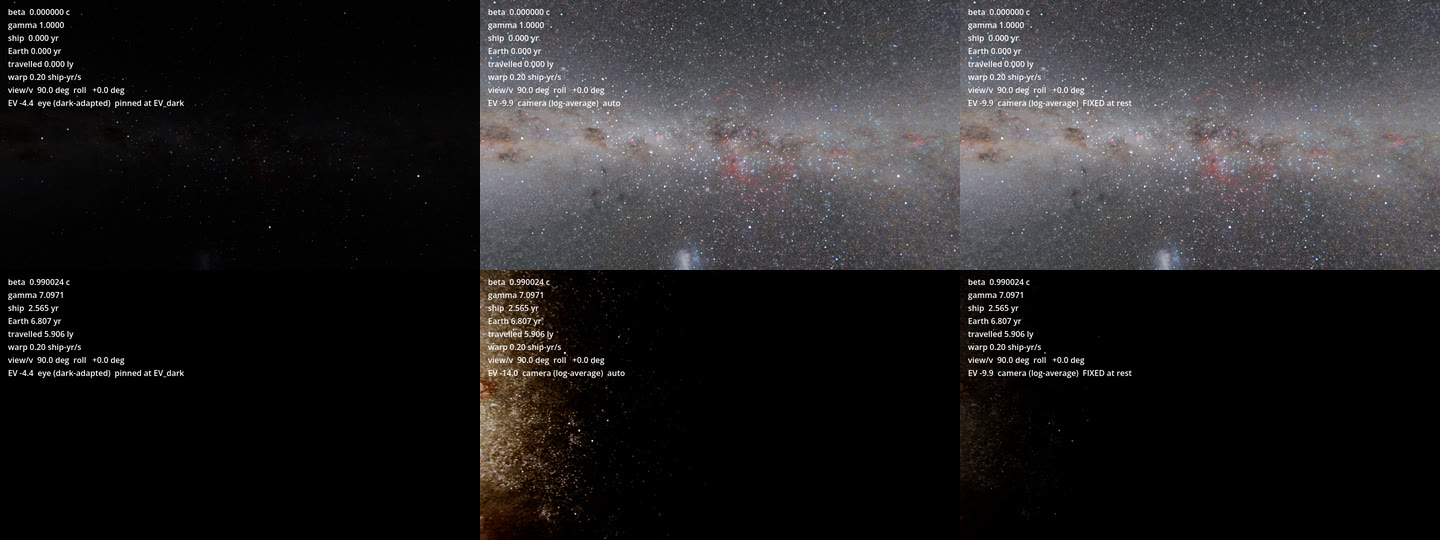
Starboard at rest (top) and at 0.99c (bottom): eye default, camera auto, camera fixed at the rest EV.
D-23PhysicsText

α Centauri at the catalogue distance, 4.32 ly

Question

α Cen distance in M4 (design OQ4, plan Q1): the HB rows and the Archive lore use 4.37 ly, but the catalogue after D-19 gives 4.32 ly, so the HUD and the Archive would differ by about 1 %. Options: a design-repo change setting HB-4 to the catalogue value and regenerating the dependent HB rows and entries from the package / keep 4.37 for the scripted checks and list the gap.

Ruling

DECIDED (Mark, attended 2026-10-03): change the design canon to the catalogue distance, 4.32 ly (HB-4 and the dependent HB rows and Archive entries regenerated from the package), so HUD and Archive agree.

Provenance

design_docs/planned/r1/m4-first-journey.md Open questions 4; plan Q1.

Recorded rulingAudioAIVoice casting Revisit

The Medic's voice: Aoede, after an audition

Revisit: Pending: the Medic's voice waits for an audition of three voices (⏸ C).

Question

Which generated voice speaks for the Medic?

Ruling

Voice: Aoede after an audition (three voices) (lands in AI.10b, ⏸ C).

Provenance

D-20 ruling 9 (Mark, attended 2026-10-02), as applied in the AI sprint plan; the audition is pause point C.

Placeholder
Placeholder: stub tone until the audition picks a voice.
Recorded rulingTextAudioAIMarkers

Emotion markers are {emotion}; speech per segment

Question

How are emotion markers written in generated text, and how is speech generated?

Ruling

Marker syntax: {emotion} (lands in AI.1). TTS granularity: Per segment, concatenated (lands in AI.10a).

Provenance

D-20 rulings 6 and 7 (Mark, attended 2026-10-02), as applied in the AI sprint plan.

D-21TextAIGenerated text

No digits in generated text; length caps 280/280/600

Question

AI text constraints flagged by the AI.2 evaluation: should no-digits apply to news and Archive text too, and what are the per-purpose length caps?

Ruling

DECIDED (Mark, attended 2026-10-02): no-digits applies to EVERY generated text (crew lines, news, Archive), so numbers on screen come only from sim fields and prose refers to them in words; per-purpose length caps are 280 characters for crew lines, 280 for news items (raised from 200), and 600 for Archive answers.

Provenance

eval_R1-AI-FOUNDATION-AI.2_round_1.json; sim/ai.ail maxCharsFor.

D-19VisualPhysicsProcessExposure

Remaining sky plan; the naked eye is the default exposure

Question

M1 remaining-work plan (sprint R1-M1-SKY-2) and its open questions: alpha Cen A/B distance, default exposure, PR #43 merge order, and the planner's defaults (Hipparcos photometry fill, Python fallback retired, bright tier committed, map content, CMB in M1, D-6 canon wording).

Ruling

APPROVED (Mark, attended 2026-10-02): sprint R1-M1-SKY-2 approved, start wave 1; merge PR #43 (AILANG destar) before the dependent milestones; alpha Cen A and B both at the CNS5 system distance 4.32 ly, separated on the sky (no literature override; B never uses its own 4.09 ly Hipparcos value); default exposure is the dark-adapted naked eye with camera-like as a labelled setting; planner defaults accepted: fill Hipparcos photometry into CNS5 rows Gaia cannot measure, retire the Python fallback and move stats/audit…Read the full ruling

APPROVED (Mark, attended 2026-10-02): sprint R1-M1-SKY-2 approved, start wave 1; merge PR #43 (AILANG destar) before the dependent milestones; alpha Cen A and B both at the CNS5 system distance 4.32 ly, separated on the sky (no literature override; B never uses its own 4.09 ly Hipparcos value); default exposure is the dark-adapted naked eye with camera-like as a labelled setting; planner defaults accepted: fill Hipparcos photometry into CNS5 rows Gaia cannot measure, retire the Python fallback and move stats/audit tools to Godot, commit stars_bright.bin, galaxy map shows CNS5 + bright stars within 25 pc, forward CMB in M1 as M1.8, D-6 'goes dark sideways' canon edit waits for Mark (M1.5a ships the honest exposure).

Provenance

design_docs/planned/r1/m1-remaining-sprint.md, Questions for Mark.

The default dark-adapted eye beside the labelled camera modes.
D-17TextGameplayMap labels

Galaxy map shows catalogue distances and common star names

Question

M2 checkpoint R1 review (galaxy map and plan panel, v0.2.0-m2-map): which α Cen distance the map shows (catalogue 4.357 ly from 0.01-ly rounding vs check row 4.37 ly), star names, ratifying the executor-chosen scenario-parameter ranges, and whether to continue to M2.6b.

Ruling

R1 ACCEPTED, CONTINUE TO M2.6b (Mark, attended 2026-10-02): the map always shows the catalogue's own distance; full-precision positions come with the M1.2 catalogue tiers (alpha Cen A ~4.365 ly), and the 4.37 ly check row stays a package test, never shown in game; add common star names (alpha Centauri A, Sirius, Barnard's Star...) from a name table in M2.6b with the catalogue id as subtitle; the executor-chosen scenario-parameter ranges in the M2 design doc protocol section are RATIFIED as written.

Provenance

Review page https://claude.ai/artifact/WSyzsBATgJZVBJRSoa9E8E; release v0.2.0-m2-map; PR #28 (eval 89).

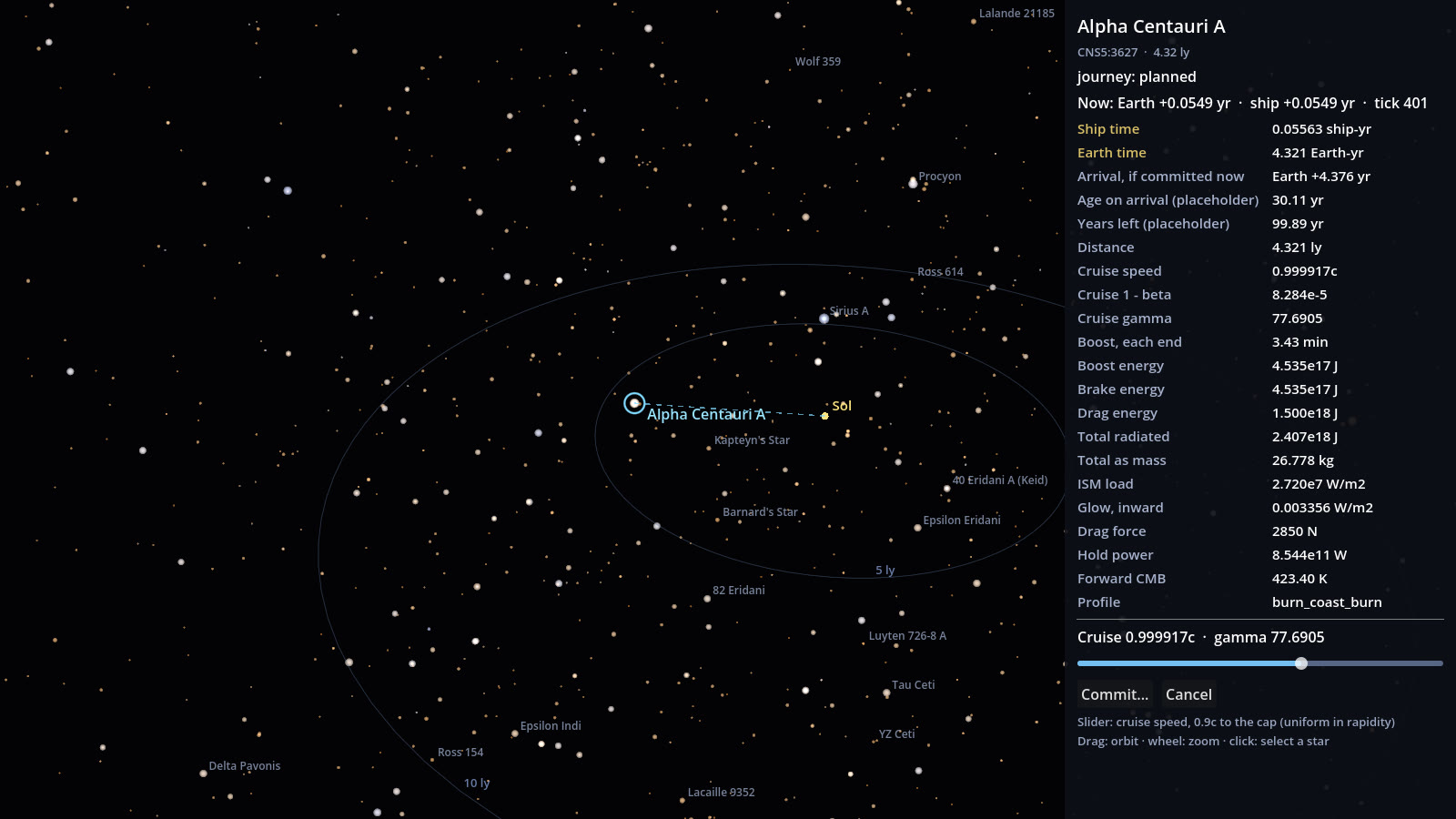
The galaxy map with common star names and the catalogue id as subtitle.
Design logPhysicsVisual

Shielding, γ Range, Boundary Optics and Bubble Defaults

Ruling

(1) The wall passes light of every energy; the crew is protected by real glazing and hull inside the bubble, which absorb the blueshifted UV and soft X-rays. No extra hand-wave. (2) The cruise slider reaches 0.999999c (γ ≈ 707); the ISM drag energy, which grows as γ·d, is the reason not to max it. The 10–20 default γ cap is retired; a cap remains a scenario parameter. (3) The boundary does not refract: light crosses undeviated, so the crew sees exactly the relativistic sky. (4) Bubble defaults: m_eff = 1 kg, boost proper acceleration 7.5×10⁵ g (about 5 ship-minutes to 0.999999c), inelastic glow fraction ε = 10⁻⁹; all scenario parameters.

Design logVisual Revisit

Art Status: Bridge v1 Approved; Iterate as Data

Revisit: Bridge v1 is demo art; final art in progress.

Ruling

Bridge style frame v1 (2026-09-28, "ok its a good first pass") is approved for build-out. The Medic v2 images are superseded by the accepted illustrated cast. The exterior style frames remain to be reviewed. Art is modular data: the game runs on the current bundle (blockout, then bridge v1, then revisions), each delivery gets a review build, and tweaks arrive as data wherever possible.

In Mark's words

"I thought we did do art direction"; "looking to get something up so I can review it, and then we can tweak as we go? so we will have it modular enough to work with it?"
Bridge v1 in the engine (demo art).
D-16VisualBridge and Medic Revisit

Bridge v1 approved for build-out; Medic review stage closed

Revisit: Bridge v1 is demo art: approved for build-out, iterated as data; final bridge art (v2) is in progress.

Question

Art status for M4: does bridge style frame v1 ('ok its a good first pass', 2026-09-28) count as sign-off for build-out (M4 stop S2), and the status of the exterior/Medic v2 and crew-exterior studies.

Ruling

DECIDED (Mark, attended 2026-10-01: 'I thought we did do art direction'): bridge style frame v1 is APPROVED for build-out, so M4 stop S2 is satisfied and a Blender agent may start ship-interior-blender-brief section 7 step 2; the Medic v2 images (style_revision_v2) are superseded by the accepted illustrated cast (cast_marker_v1); the exterior style frames remain to be reviewed.

In Mark's words

I thought we did do art direction

Provenance

~/dev/blender docs/stapledon/bridge_style_v1, style_revision_v2, crew_exterior_style_v1; art/README.md review state.

Bridge v1 in the engine, live sky behind (demo art).
Bridge v2 quality study: style study, final art in progress.
D-15PhysicsVisualGlazing

Glazing, the γ range, boundary optics, bubble defaults

Question

Bubble follow-ups from the D-11 canon write-up: radiation shielding vs a wall passing light of every energy, the γ cap, boundary refraction, and M2 OQ6 bubble defaults (m_eff, boost_g, ε).

Ruling

DECIDED (Mark, attended 2026-10-01): (1) the wall passes light of every energy and the crew is protected by real glazing and hull inside the bubble, which absorb the blueshifted UV/X-rays; 'Radiation Shielding Automatic' (2025-12-06) is superseded in part, no extra hand-wave; (2) the cruise slider reaches 0.999999c (gamma ~707) with the ISM drag energy (~gamma*d) as the natural brake; the 10-20 default gamma cap is retired, a cap stays a scenario parameter; (3) the boundary does not refract, so the crew sees exactly the relativistic sky; (4) M2 OQ6 bubble defaults m_eff = 1 kg, boost proper acceleration 7.5e5 g, inelastic glow fraction epsilon = 1e-9, all scenario parameters.

Provenance

stapledons-design PR #2 open points; M2 OQ6.

D-14GameplayVisualTextArt stop

First-journey defaults (0.99c, 1,000 AU stand-off, art stop)

Question

M4 open questions (orientation, slice cruise speed, stand-off, calendar, news beat, art stop S2, playtest incl. bar clause 4, time while docked).

Ruling

M4 OQs DECIDED (Mark, attended 2026-10-01): no flip exists, up = direction of travel throughout; slice default cruise 0.99c for Sol -> alpha Cen (player can change it); journeys stop 1,000 AU from the target star; relative calendar; the news beat is a text panel at the Archive terminal; art stop S2 WAITS for Mark's approval of the Blender bridge style frame (no shipping on the spike blockout); R1 uses the scripted minimum-path proxy for the under-10-minutes bar and the 3-new-player human playtest moves to R2 (bar clause 4 amended); time while docked follows D-12 (no pause).

Provenance

design_docs/planned/r1/m4-first-journey.md Open questions.

D-12GameplayText

Calendar, manual flight and the commit ritual

Question

M2 remaining open questions (OQ3 calendar, OQ4 manual flight and pausing, OQ5 commit ritual).

Ruling

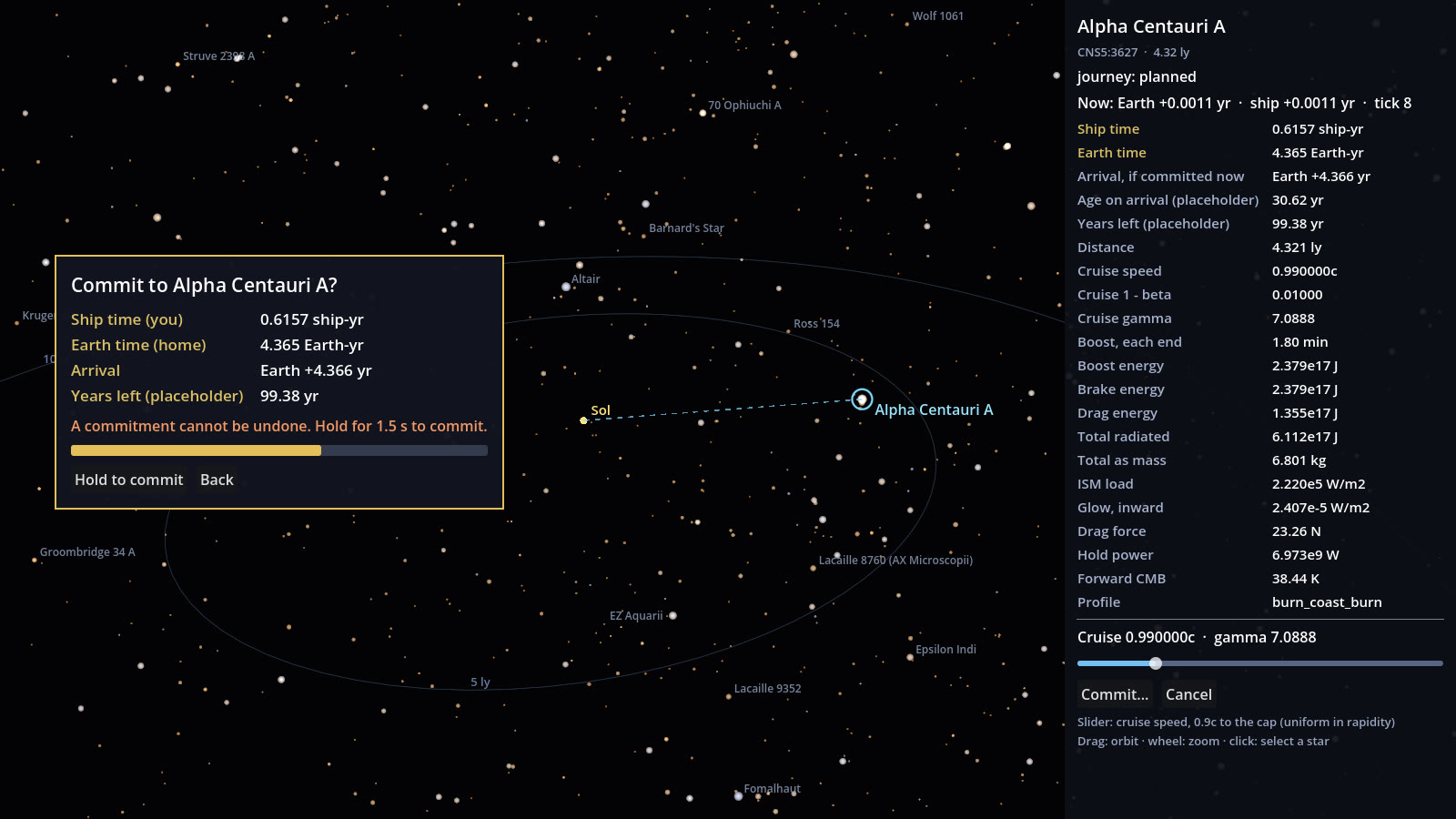
M2 OQ3-OQ5 DECIDED (Mark, attended 2026-10-01): calendar is relative ('Earth +6.003 yr') with epoch and start_age as scenario parameters, start_age 30; manual thrust only in diag sessions, in play the clock runs at rest at a fixed host rate with no pause while planning; commit ritual is one dialog showing both clocks and the years left at home with a 1.5 s hold.

Provenance

design_docs/planned/r1/m2-journey-core.md Open questions.

The commit ritual: both clocks, years left, a 1.5 s hold.
D-10VisualPhysicsSky

Milky Way background: the NOIRLab panorama

Question

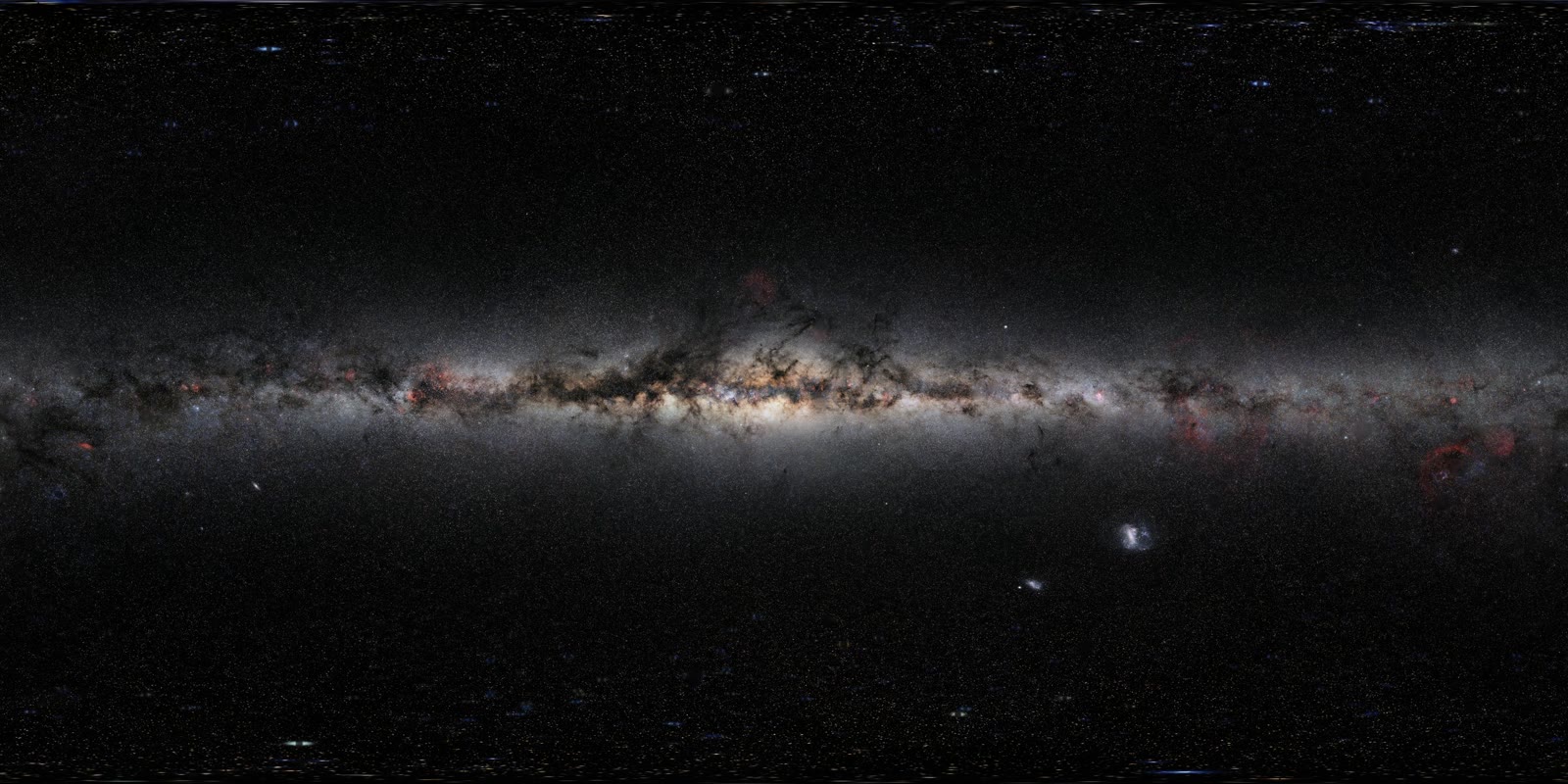
M1.4a background source (M1 design open question 1): Option A on which panorama, NOIRLab noirlab2430b (E. Slawik, 10000×5000, CC BY 4.0) or ESO eso0932a (S. Brunier, CC BY 4.0)? Gaia EDR3 flux map ruled out (built from stars, no nebulae, CC BY-SA).

Ruling

OPTION A ON NOIRLAB (Mark, attended 2026-10-01: 'ok lets go with NOIRlab'): the background is the real NOIRLab noirlab2430b panorama (E. Slawik, CC BY 4.0, 10000x5000), with the point sources that are cross-matched to the shipped point layers (CNS5, GCNS, HIP2 V<7) masked and inpainted, and unmatched faint stars kept as pixels. ESO eso0932a and the Gaia EDR3 flux map are not used. The panorama is valid to about 50 ly from Sol (parallax); beyond that it is a stated post-R1 limit.

In Mark's words

ok lets go with NOIRlab

Provenance

Attended spike, branch m1.4a-background-spike, docs/m1.4a/README.md (matched-window crops, parallax validity note: a single panorama holds to about 50 ly from Sol).

The NOIRLab panorama with the catalogue stars removed.
Design logVisualGameplay

Interior: Isometric Three-Layer View From Inside the Bubble

Context

the log contradicted itself: isometric tiles (the original bridge design), first-person 3D (2025-12-18), and fixed AI-painted scenes (2025-12-20). The fixed-scene pivot happened only because AI images couldn't give consistent assets. Blender removes that constraint. Three feasibility spikes (stapledons-godot branch spike/iso-bridge, v1–v3) tested the options visually with the live physics.

Ruling

- The player is inside the bubble. Up = forward = the direction of travel. *(Amended 2026-10-19, D-92: travel lies in the deck plane, toward the bow.)* - Isometric play areas are built as Blender 3D models, rendered in Godot through an orthographic camera tilted back (about −14°) at room scale (about 16 m in view). The player walks around. Shading is toon plus ink. - Behind the play area: Blender interior panoramas of the ship's own structure (spire, levels, far decks), rendered from inside with space left…Read the full ruling

- The player is inside the bubble. Up = forward = the direction of travel. *(Amended 2026-10-19, D-92: travel lies in the deck plane, toward the bow.)* - Isometric play areas are built as Blender 3D models, rendered in Godot through an orthographic camera tilted back (about −14°) at room scale (about 16 m in view). The player walks around. Shading is toon plus ink. - Behind the play area: Blender interior panoramas of the ship's own structure (spire, levels, far decks), rendered from inside with space left transparent. Each panorama camera is exported. - Behind those: the live relativistic sky (catalogue stars and a full-sky galaxy), rendered through *exactly* that exported camera. - Parallax on every layer: the sky and galaxy stay fixed (at infinity), the panorama moves slowly, the play area moves 1:1, and the foreground silhouettes move fast. - The bridge sits at the top of the spire, and its dome is the bubble's forward pole. The starbow gathers overhead there. *(Amended 2026-10-19, D-92: the starbow gathers ahead, over the bridge's bow rail; the bridge's dome is no longer the forward pole.)* Lower decks see the sky past the level rims, and it goes dark sideways at speed. That's physics, and it's what makes the bridge the place to watch from. - Conversations use large portraits. - Art direction is unchanged: French 70s comics, Moebius / Métal Hurlant (2025-12-08).

Rationale

Pillar 3 (Time Has Emotional Weight): the cosmos going dark around the lower decks at speed and blazing at the bow makes the journey visceral from inside daily life. Pillar 4 (The Ship Is Home): the player walks the ship among the crew. Pillar 5 (Grounded Strangeness): every star is where physics puts it, because the sky is rendered through the panorama's own camera.

Design logVisual

Character and Exterior Review: Static Portraits and a Spherical Ship

Context

Mark reviewed the first Blender Medic character study and the first exterior style frame after accepting the bridge as a good first pass.

Ruling

- Replace the rejected Blender character-study direction with richer, expressive generated portrait images. Change expressions by selecting images; character animation is not required. Use matching small static avatars. - Character portraits no longer depend on one shared Blender model, a rig, shape keys or animation clips. Keep identity, age, clothing and palette consistent between the illustrated portraits and mini avatars. - The ship's containing bubble is a perfect sphere, not an elongated egg. - Integrate the…Read the full ruling

- Replace the rejected Blender character-study direction with richer, expressive generated portrait images. Change expressions by selecting images; character animation is not required. Use matching small static avatars. - Character portraits no longer depend on one shared Blender model, a rig, shape keys or animation clips. Keep identity, age, clothing and palette consistent between the illustrated portraits and mini avatars. - The ship's containing bubble is a perfect sphere, not an elongated egg. - Integrate the forest as a level inside the sphere. Remove the outboard tree/annex treatment from the exterior direction. - Show a readable representation of the bubble boundary in exterior reviews. The existing rule that the engine renders physical boundary glow still applies.

In Mark's words

the character study is aweful. I think we will instead generate images that are much richer and expressive, and not use animation, just change expression as we go. so no blender for that or no? we can use mini avatars for them. the exterir looks more like a long egg rather than a perfect sphere the story prefers, and what is that tree that is outside the rest of the sphere? we can havea . forest level, makes sense. we also need some represtntaion of the bubble itself.

Rationale

The first character study did not deliver the emotional richness Mark wants from conversations. The exterior must communicate the established spherical ship and contain its inhabited forest visibly within that volume.

D-8AIAudio

Runtime AI: the player's own key, model-neutral, no live voice

Question

Runtime AI operating model (ai-showcase open questions 1–3): keys and cost, providers, live voice.

Ruling

DECIDED (Mark, attended 2026-09-28). (1) KEYS AND COST: the PLAYER'S OWN KEY. The game ships PRE-GENERATED CORE CONTENT (the accepted founding cast, their portraits, avatars and voices, the Archive, and templated fallback lines), and live generation is OPT-IN with the player's key. Without a key the game is fully playable on the pre-generated core. (2) PROVIDERS: stay MODEL-NEUTRAL and swap models as needed through AILANG's provider routing; GEMINI is the default (text, image and TTS). (3) VOICE: NO LIVE real-time voice for now (no streaming conversation with the Archive; gemini_live deferred). Speech is PRE-RECORDED or generated per line and cached, and TEXT-ONLY mode is always available.

Provenance

Attended session 2026-09-28; features/ai-showcase.md §7.

D-6VisualGameplayInterior

Interior: isometric three-layer view under the live sky

Question

Ship-interior presentation for M4 (resolves the isometric / first-person / fixed-scene contradiction in the design docs: design-decisions 2025-12-18 vs features/scene-based-interior-navigation 2025-12-20).

Ruling

ISOMETRIC THREE-LAYER INTERIOR (Mark, attended 2026-09-28, 'yes this is more like it - lets go with these', after spikes v1-v3). The player is INSIDE the bubble; up = forward (direction of travel). Isometric play areas built as Blender 3D models (GLB), rendered in Godot with an orthographic camera tilted back (~-14 deg) at room scale (~16 m), toon + ink shading, the player walks around. Behind them: Blender interior panoramas of the ship's own structure (spire, levels, far decks), rendered from inside with space…Read the full ruling

ISOMETRIC THREE-LAYER INTERIOR (Mark, attended 2026-09-28, 'yes this is more like it - lets go with these', after spikes v1-v3). The player is INSIDE the bubble; up = forward (direction of travel). Isometric play areas built as Blender 3D models (GLB), rendered in Godot with an orthographic camera tilted back (~-14 deg) at room scale (~16 m), toon + ink shading, the player walks around. Behind them: Blender interior panoramas of the ship's own structure (spire, levels, far decks), rendered from inside with space left transparent and each camera exported. Behind those: the live relativistic sky through EXACTLY that camera (catalogue stars + full-sky galaxy, per-pixel inverse aberration and Doppler). Parallax on every layer when panning: sky and galaxy fixed (at infinity), panorama slow, play area 1:1, foreground silhouettes fast. The bridge sits at the top of the spire and its dome IS the bubble's forward pole, where the starbow gathers overhead; lower decks see the sky past the level rims, which goes dark sideways at speed. Character interactions use large portraits. Art direction: Moebius / Metal Hurlant (2025-12-08). Supersedes design-decisions 2025-12-18 (first-person 3D) and the no-avatar fixed-scene model of scene-based-interior-navigation (2025-12-20); keeps the 2025-12-08 ship canon.

In Mark's words

yes this is more like it - lets go with these

Provenance

Attended session 2026-09-28; feasibility spikes v1–v3 on branch spike/iso-bridge.

The three layers in the engine: play area, ship structure, live relativistic sky.
D-5PhysicsVisualSky

A bright-star tier from Hipparcos

Question

Bright-star tier (M1 design open question 5): accept the proposed M1.2d, a Hipparcos (HIP2, VizieR I/311) tier for V < 7 stars not in GCNS or CNS5, with AC11 and teffFromBV in sunholo/relativity 0.3.0 (about +250 LOC)? Without it Rigel, Deneb and most naked-eye stars beyond 100 pc exist only as panorama pixels (option A) or not at all (option B).

Ruling

ACCEPTED (Mark, attended 2026-09-28: 'Yes I accept those stars'): add M1.2d, a Hipparcos (HIP2, VizieR I/311) tier for V < 7 stars not in GCNS or CNS5, with AC11 and teffFromBV in sunholo/relativity 0.3.0 (about +250 LOC), so Rigel, Deneb and the naked-eye sky beyond 100 pc are real catalogue stars.

In Mark's words

Yes I accept those stars

Provenance

Quorum round 1 (oc-glm-5-3), 2026-09-28; design doc Problem 5, rows V14 and M1.2d.

D-4PhysicsVisualSky

White dwarfs: approximate blackbody, flagged

Question

White dwarfs in M1: approximate blackbody fit, flagged approximate (design open question 3).

Ruling

YES: approximate blackbody fit for white dwarfs in M1, flagged approximate in data and UI (Mark, attended 2026-09-28: "record decisions as ratified").

In Mark's words

record decisions as ratified

Provenance

Handover comment on #1; photometry 0.2.0 deliberately has no WD model.

Design logVisualGameplaySuperseded

Interior Ship Experience: Scene-Based Navigation (recorded retroactively)

Ruling

fixed-camera scenes per deck, built from AI-generated 2D/2.5D images with parallax, reached through a deck-selection UI, with crew as sprites plus emotion portraits and no walking avatar. Isometric tiles and first-person 3D were both rejected, because AI generation couldn't produce consistent assets and walking pulled focus from conversations. See features/scene-based-interior-navigation.md. > This entry was missing from the log. It is recorded here for completeness, > and it is superseded in part (2026-09-28) by the next entry.

Design logVisual

Visual Aesthetic: French 70s Comic (Moebius/Métal Hurlant)

Ruling

The ship's visual style draws from French 70s science fiction comics, particularly Moebius (Jean Giraud), Philippe Druillet, and Métal Hurlant magazine. Key characteristics: (1) Organic/mechanical blend - technology that looks grown, (2) Saturated colors against vast emptiness, (3) Tiny humans against massive structures for scale contrast, (4) Clean flowing curves over sharp angles, (5) Cathedral-like spaces that evoke awe. This replaces the earlier 'clean functional sci-fi' aesthetic in bridge-interior.md.

Design logPhysicsVisual

Ship Orientation: Vertical Thrust Axis with 1g Gravity

Ruling

The ship is oriented vertically along the thrust axis. The spire runs from engines (bottom/aft) to observation deck (top/forward). Continuous 1g thrust provides artificial gravity - 'down' is toward the engines, 'up' is toward the direction of travel. Levels are stacked along this axis, with open sides facing outward toward the bubble boundary. This means when standing on any level, you look UP toward the bridge and DOWN toward engineering.

Design logVisualPhysics

Parallax and SR Visual Thresholds

Ruling

Implement tiered visual physics based on ship speed: <0.1c uses boundary glow only, 0.1-0.3c adds faint aberration, 0.3-0.5c shows nearby star parallax, 0.5-0.9c has strong aberration (60°→26° cone), >0.9c produces extreme starbow effect. Dual view modes: 'Raw SR View' (physically accurate aberration/Doppler) and 'Navigation View' (computer-compensated with enhanced parallax). Local system parallax (planets, moons) is always visible when near objects - only stellar parallax requires high speeds.

Design logVisual

Open Levels: Views Outward Through Bubble

Ruling

Levels are mostly open to the sides, providing direct views outward through the transparent bubble boundary to space. Players see: (1) Close-up visual effects with parallax at the bubble boundary, (2) Stars and planets beyond with SR/GR effects applied based on velocity, (3) The bubble glow from ISM impacts. This creates constant visual connection to the cosmos from daily life - you're always aware you're hurtling through space.

Design logVisualGameplay

Higgs Bubble Ship: 10-20+ Levels Around Spire

Ruling

The ship interior is 10-20+ levels radiating outward from the central Higgs Generator Spire. Each level serves different purposes: Command (bridge, observation), Residential (small houses, dwellings), Gardens/Cathedral (remembrance, culture), Industrial (engineering, fabrication), Commons (markets, gathering), Archive (AI shrine). Levels are mostly open to the sides with views outward. Navigation is via various lifts and ramps of different sizes arranged somewhat chaotically.

Design logVisualPhysics

Departure-Cruise-Arrival Parallax Lifecycle

Ruling

Parallax visibility follows a natural lifecycle: DEPARTURE (rich local parallax from planets/moons, lasting minutes to days as you leave a system), INTERSTELLAR CRUISE (parallax desert - stars too far apart, motion cues from boundary glow and SR effects only), ARRIVAL (parallax returns as destination system objects become resolvable). This means 'artificial dust layers' are only needed during cruise phase - departure and arrival have natural 3D geometry.

Design logVisualPhysicsSuperseded

Boundary Glow as Motion Cue

Ruling

The Higgs bubble boundary glows when particles from the ISM impact it at speed. Since mass cannot pass through (per bubble-constraint), kinetic energy converts to visible light at the boundary. Effect scales with both velocity and local ISM density: faint in deep space, bright near stars (stellar wind), intense in nebulae. Forward-facing glow is strongest, providing heading feedback. This replaces 'fake space dust' with a physically-justified motion cue.

Design logVisualGameplay

Observation Deck as Decision Hub

Ruling

The observation deck / bridge at the top of the ship is the primary location for major decisions. Captain makes choices with cosmic backdrop - starfields, SR/GR effects visible.

Design logVisualGameplay

Garden Cathedral

Ruling

The "garden cathedral" in the outer shell is a gameplay-significant location. It's where: - Crew remember Earth and what it meant to live on a planet - Cultural rituals develop over generations - Philosophical conversations and processing happen - The bubble society's culture crystallizes Emotionally: "sad but happy" - bittersweet remembrance.

Design logVisualPhysics

Special Relativity Visual Effects: Hard SF Made Visible

Context

Relativistic travel is central to the game, but players need to SEE it, not just read numbers. The question was how to make SR tangible without resorting to fake "warp streaks."

Ruling

Implement three physically accurate SR effects at high γ (10-20): 1. Aberration (Headlight Effect): Stars pile into a forward cone as speed increases. At high γ, almost everything is visible in a narrow tunnel ahead; behind is blackness. The universe "rushes toward" your velocity vector. 2. Doppler Shift: Light from ahead blue-shifts (stars become blue/white). Light from behind red-shifts (fades to infrared and disappears). Nebulae get blue tint ahead, red smear behind. 3. Relativistic Beaming: Intensity scales…Read the full ruling

Implement three physically accurate SR effects at high γ (10-20): 1. Aberration (Headlight Effect): Stars pile into a forward cone as speed increases. At high γ, almost everything is visible in a narrow tunnel ahead; behind is blackness. The universe "rushes toward" your velocity vector. 2. Doppler Shift: Light from ahead blue-shifts (stars become blue/white). Light from behind red-shifts (fades to infrared and disappears). Nebulae get blue tint ahead, red smear behind. 3. Relativistic Beaming: Intensity scales as I' ∝ D³ where D is Doppler factor. Forward directions become much brighter (blow out into "star wind" halo). Rear directions dim to near-black. Additionally: External clocks (remote beacons, planet rotations) run "too fast" as you approach high speed. HUD shows "galaxy time" vs "ship time" advancing at different rates.

Rationale

Serves Pillar 3 (Time Weight): Visual distortion makes time dilation visceral, not abstract. Serves Pillar 5 (Grounded Strangeness): Real physics that's actually visible. Serves Pillar 6 (Human Incompatibility): Disorienting visuals emphasize cosmic alienation—this isn't how humans evolved to see.

See also the roadmap.