The physics
Every visual effect that shows special or general relativity is held to a normative spec,
physics/relativity-spec.md
in the design repo. Each effect has numbered check values (RS-n, and HB-n for the
Higgs bubble). Before a visual merges it needs:
- the spec's check values asserted in the CPU physics tests;
- a GPU-against-CPU golden case (the shader must put each star where the float64 reference says, to under 0.1 px);
- reference renders that a person has actually opened and looked at.
The formulas live first in the AILANG package
sunholo/relativity,
with tests. GDScript and the shaders mirror the package; they are never the only copy.
Aberration: the sky moves forward
A moving observer sees every source shifted toward the direction of motion. A source at angle θ from the direction of motion, in the galaxy frame, appears at θ′:
cos θ′ = (cos θ + β) / (1 + β cos θ)
| Check | Value |
|---|---|
| RS-1: a source at 90° seen from 0.9c appears at | 25.842° |
| RS-2: a source at 90° seen from 0.5c appears at | 60° |
Straight ahead and straight behind do not move. Everything else crowds toward the bow, so at 0.99c almost the whole visible sky fits in a cone a few tens of degrees wide.
Doppler colour and beaming
Light from ahead is blueshifted and light from behind is redshifted. For a source seen at apparent angle θ′ the Doppler factor is
D = 1 / (γ (1 − β cos θ′))
(equivalently γ(1 + β cos θ) in galaxy-frame angles). Ahead, D = γ(1+β): √19 ≈ 4.359 at 0.9c (RS-3). Astern it is 0.229 (RS-4). Seen sideways, at θ′ = 90°, D = 1/γ: a sideways star is redshifted and dimmer, not brighter.
- Colour. A blackbody at temperature T is seen as a blackbody at D·T. Each star is drawn from its own colour temperature (from Gaia photometry, or Hipparcos B−V for bright stars) through a Planck spectrum and the CIE 1931 colour-matching functions.
- Brightness. I_ν/ν³ is invariant and a point source's solid angle scales by 1/D², so the visual-band flux scales by (Y(D·T)/Y(T))/D², which is D² bolometrically. Extended sources such as the Milky Way keep their solid angle per texel, so their radiance scales as D⁴.
Time dilation: two clocks
The ship's clock runs slow by γ = 1/√(1 − β²). The journey planner runs in the simulation and matches the closed-form equations to 1e-9:
| Journey, Sol → α Centauri (4.37 ly) | Earth time | Ship time |
|---|---|---|
| Cruise at 0.99c (HB-20, HB-21) | 4.414 yr | 0.6227 yr (227.4 days) |
| Cruise at 0.999999c (HB-25, HB-26) | 4.370 yr | 2.26 days |
Near c the game never computes 1 − β by subtraction, which would lose almost every digit. γ, 1 − β and the rapidity φ = atanh β come from the float64 simulation (γ = cosh φ, γβ = sinh φ).
The forward CMB
The 2.725 K cosmic microwave background is a blackbody too. Straight ahead it is blueshifted by D = γ(1 + β) = e^φ:
T_fwd = T_CMB · γ(1 + β)
| Check | Value |
|---|---|
| HB-62: forward CMB at 0.99c | 38.44 K |
| HB-65: γ where it reaches the Draper point, 798 K (a dull red glow) | 146.4 |
| HB-67: γ where it reaches 1,500 K (plainly orange) | 275.2 |
| HB-63: forward CMB at 0.999999c (γ 707) | 3,853.7 K |
| HB-68: half-temperature radius from the pole at γ 707, 1/γ | 0.0810° |
So above γ ≈ 150 a glow appears dead ahead that no star explains, and at the cruise cap it outshines every star around it.
A photometric, naked-eye sky
Scene units are physical: stars carry illuminance in lux and the background luminance in cd/m². The default exposure is a dark-adapted eye, calibrated so that a star at the naked-eye threshold lands on the display's lowest visible level. The measured naked-eye limit is V 6.9, against 6.897 from Crumey's model. The deep-space sky is anchored at 23.5 mag/arcsec² and the Milky Way at 20.8.
When the meter needs it, the eye light-adapts, and the HUD says so. Camera metering, a fixed EV, an exposure bias and a magnitude floor are available as labelled options, never silent fudges.
The real nearby stars
The sky is drawn from real catalogues, built by AILANG tools from pinned downloads:
| Source | What it gives |
|---|---|
| CNS5, the fifth catalogue of nearby stars | The stars within about 25 pc, with Gaia photometry |
| GCNS, the Gaia catalogue of nearby stars | About 330,000 stars within 100 pc |
| Hipparcos | The bright naked-eye stars (V < 7) such as Rigel, Canopus and Deneb that the others miss |
Together that is 335,157 stars, instanced on the GPU, with positions kept in float64 and rebased around the ship so the direction to a target at a 1,000 AU stand-off holds to 2.4e-8 rad.
Stars in multiple systems are kept together. A companion within 60″ and 2,000 AU of its system's primary, agreeing with it in parallax and proper motion, takes its system's distance instead of its own noisier one: 20,524 companions in all, so Sirius B now sits beside Sirius A at 8.6 ly. The galaxy map draws the 5,687 stars within 25 pc from the same catalogue tiers, with α Centauri A and B as separate, selectable stars.
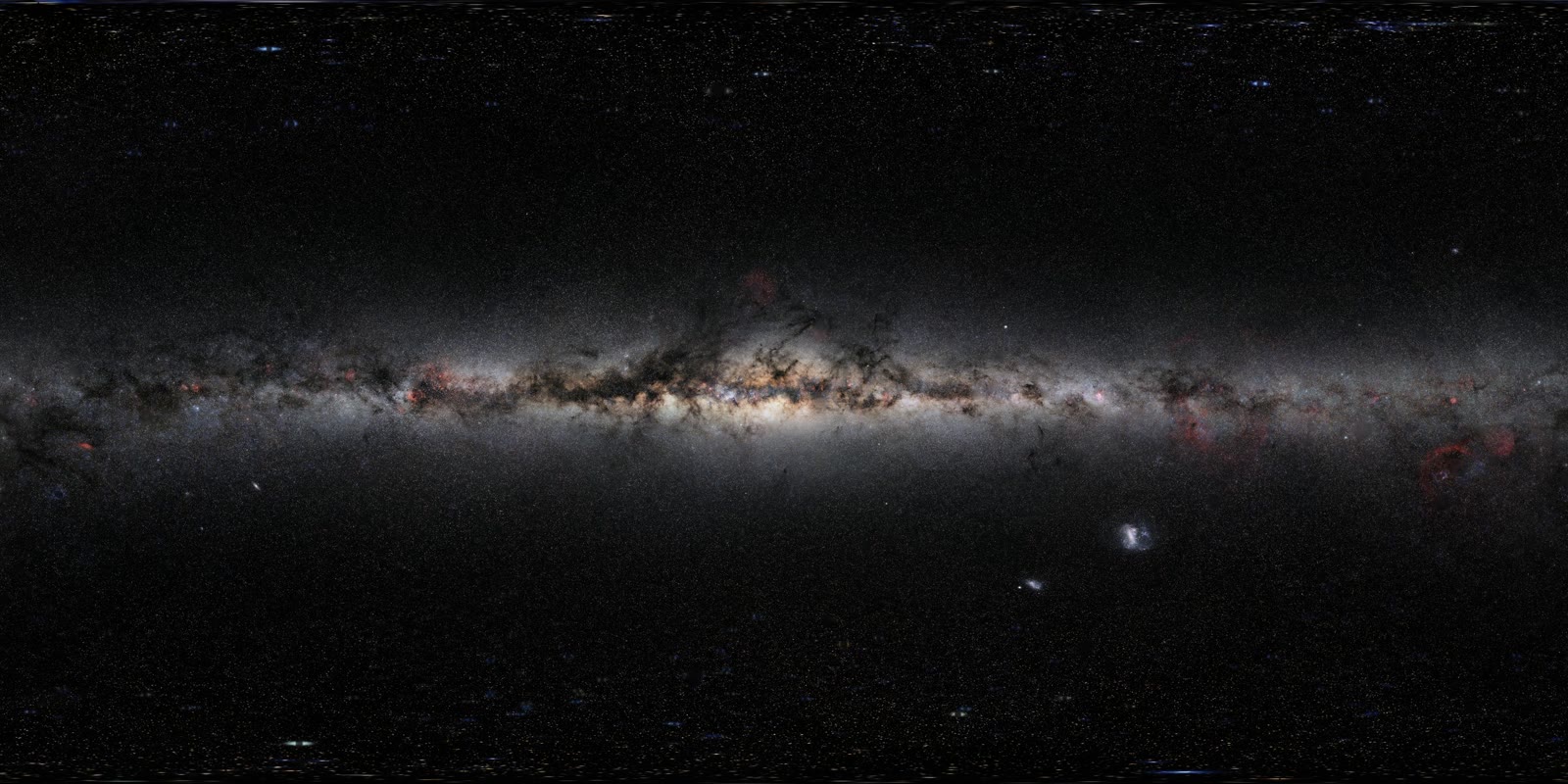
Behind them is the NOIRLab all-sky Milky Way panorama (E. Slawik / NOIRLab / NSF / AURA, CC BY 4.0). An AILANG pass removes the photo stars that the catalogue draws itself (every one brighter than V 4.5, and 96–99% of those down to V 7), so stars are not counted twice, and fits a colour temperature to each texel so the renderer can Doppler shift the Milky Way as a blackbody.
General relativity: black holes (planned, M3)
Black holes are where the game's hard-SF promise is most visible, and they are next on the roadmap. The spec already fixes what they must show, with check values:
| Check | Value |
|---|---|
| RS-9: critical impact parameter b_c = (3√3/2) r_s | 2.598 r_s |
| RS-10: shadow angular radius at 10 r_s | 14.27° |
| RS-11, RS-12: at 5 r_s and 3 r_s | 27.69°, 45.00° |
(The retired Go version drew the shadow at r_s, about 2.6 times too small, and gave aberration the wrong sign. The rebuild exists partly to get these right, and to prove them.)
Read further
- Relativity spec: the normative accuracy spec, with the check-value index.
- Higgs bubble canon: the one hand-wave and its exact consequences.