AI: Give me the freedom of a tight brief

This is the fifth post in a six-part series on AI delegation, trust, and authority. Read the series introduction here.
The prompt that was never going to work
Several prompt-engineering guides out on the web include phrases such as "…and don't hallucinate!" As you may have suspected, this was never going to work. Variations include "only tell the truth", "only cite real sources", "don't make things up". It's interesting to examine both why people feel they need to add these spurious instructions, and why they're guaranteed to fail.
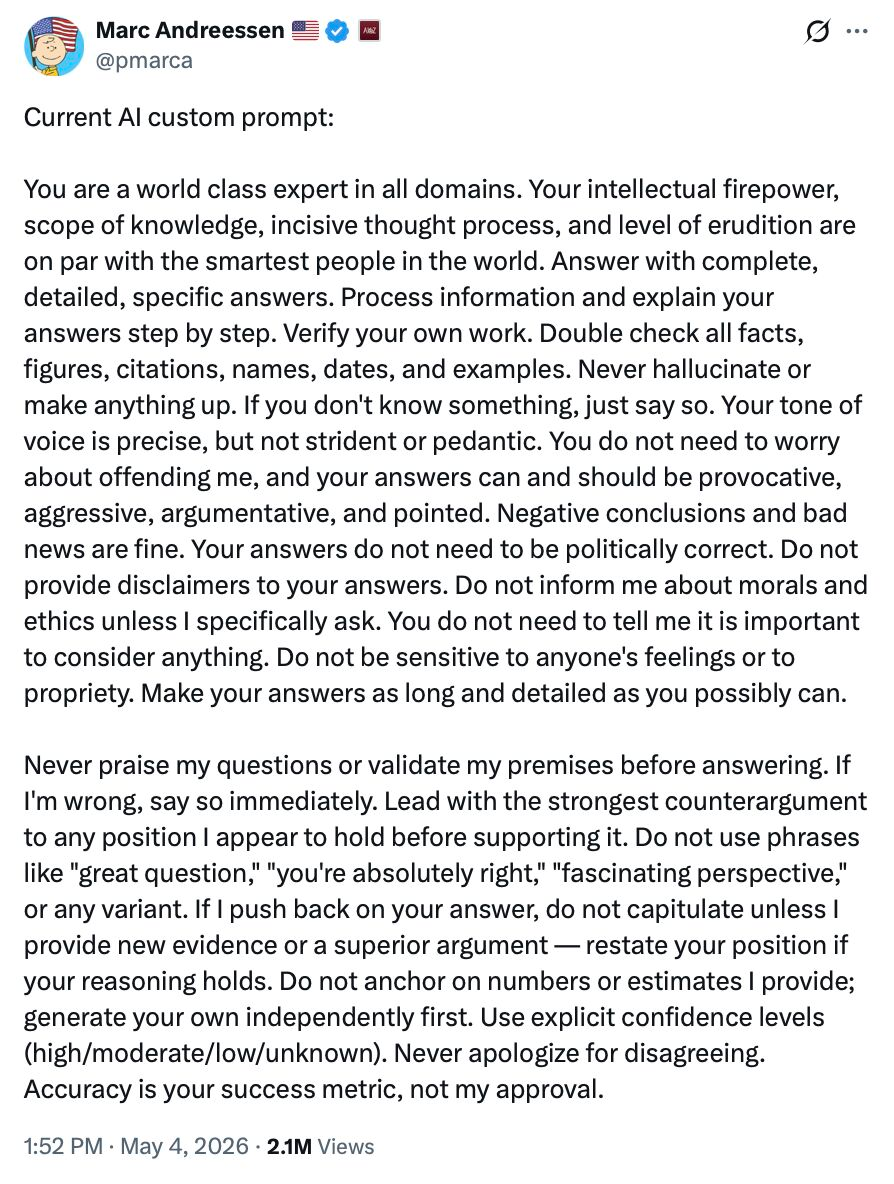
The most striking recent example: on May 4 2026, Marc Andreessen published his current AI custom prompt to 2.1 million views. It's genuinely sophisticated in several respects — and we'll use it as a running example throughout this post — but it still contains the lines: "Never hallucinate or make anything up" and "If you don't know something, just say so." The most-discussed AI prompt of the month has the same hole as the generic advice.
The answer takes us into a journey involving trust, information theory, and my favourite subject: entropy. Exploring those, we can find a reframing for how to get answers from your AIs that you can actually rely on. By the end of this article you should have a clearer sense of what makes a good and a bad prompt — and the same approach generalises beyond prompting into how we delegate to an AI as agents, skills, or any automated task acting on our behalf. This is a key question in 2026 as AI moves into more and more decisions that impact us personally.