20 posts tagged with "ailang"

View All Tags

Shining a light into a dark software factory: AI loop engineering

· 10 min read

There is a lot of noise in AI trends which can seem abstract or theoretical to those not following every day, so I’ll try not to add to that but instead show a public example of a living, breathing open source project and how it is using terms like “loop engineering”, “dark factories” and “agent graphs” to get things done today.

Who needs Fable? Matching frontier coding performance with local open-source models using AILANG and motoko coding harness

· 11 min read

As you may have heard, Anthropic was forced by the U.S. administration to revoke access to its latest Fable 5.0 model due to security concerns, and it may only come back as usable by U.S. citizens. This has sparked off various reactions across Europe on AI sovereignty which should be addressed.

Any AI that can not say 'I don't know' may be lying to you

· 10 min read

This is the sixth post in a series on AI delegation, trust, and authority. Read the series introduction here. Earlier posts cover authority, reproducibility, visibility, and decision budgets.


One consequence of AI being trained to be so eager to please — the "helpful assistant" persona baked in via reinforcement learning — is that it will make things up. This is perhaps the first difference we must internalise, and where we should be careful not to anthropomorphise the machine too readily. If a human makes things up, we suspect deceit and ulterior motives. An AI's motives are fashioned by that eager-to-please training: it invents references (hallucinations) because it's trying to please you. This raises real questions about how adversarial we want AI to be — an AI trained for brutal honesty may give us better truth-tracking, but at the cost of the compliance that makes it useful in the first place. For now, we can build trust in AI only if we give it a way out to say "I don't know". Most hallucinations I see these days are the prompt's fault rather than the AI's.

The chatbot that told New Yorkers to break the law

An example of where this goes seriously wrong is when an AI is deployed in a responsible, public-facing position with no refusal path. New York City's MyCity chatbot is the most documented case.

  • October 2023 — NYC launches MyCity, a Microsoft-powered chatbot intended to help small business owners navigate city regulations.
  • March 2024 — The Markup (Colin Lecher) tests it against actual NYC law. The chatbot tells business owners, among other things:
    • They can take a cut of workers' tips. (They can't — it's wage theft.)
    • They can fire workers who complain about harassment. (They can't — retaliation is illegal.)
    • They don't have to accept Section 8 housing vouchers. (They do — source-of-income discrimination is illegal in NYC.)
    • Rent-stabilised apartments can be turned into condos without tenant consent. (They can't.)
  • Mayor Adams defends the tool through 2024 as a "work in progress."
  • January 2026 — Mayor Mamdani's administration announces MyCity will be shut down, citing unfixable hallucination risk and active harm to small business owners who relied on it.

The diagnosis that ties the series together: MyCity didn't lack knowledge. It lacked a refusal path. Every one of those answers should have been "I don't know — consult a lawyer or call 311." Instead, every one was a confident paragraph.

AI: Give me the freedom of a tight brief

· 27 min read

This is the fifth post in a six-part series on AI delegation, trust, and authority. Read the series introduction here.

Decision budget — vector visualisation showing entropy collapsing across five axes

The prompt that was never going to work

Several prompt-engineering guides out on the web include phrases such as "…and don't hallucinate!" As you may have suspected, this was never going to work. Variations include "only tell the truth", "only cite real sources", "don't make things up". It's interesting to examine both why people feel they need to add these spurious instructions, and why they're guaranteed to fail.

The most striking recent example: on May 4 2026, Marc Andreessen published his current AI custom prompt to 2.1 million views. It's genuinely sophisticated in several respects — and we'll use it as a running example throughout this post — but it still contains the lines: "Never hallucinate or make anything up" and "If you don't know something, just say so." The most-discussed AI prompt of the month has the same hole as the generic advice.
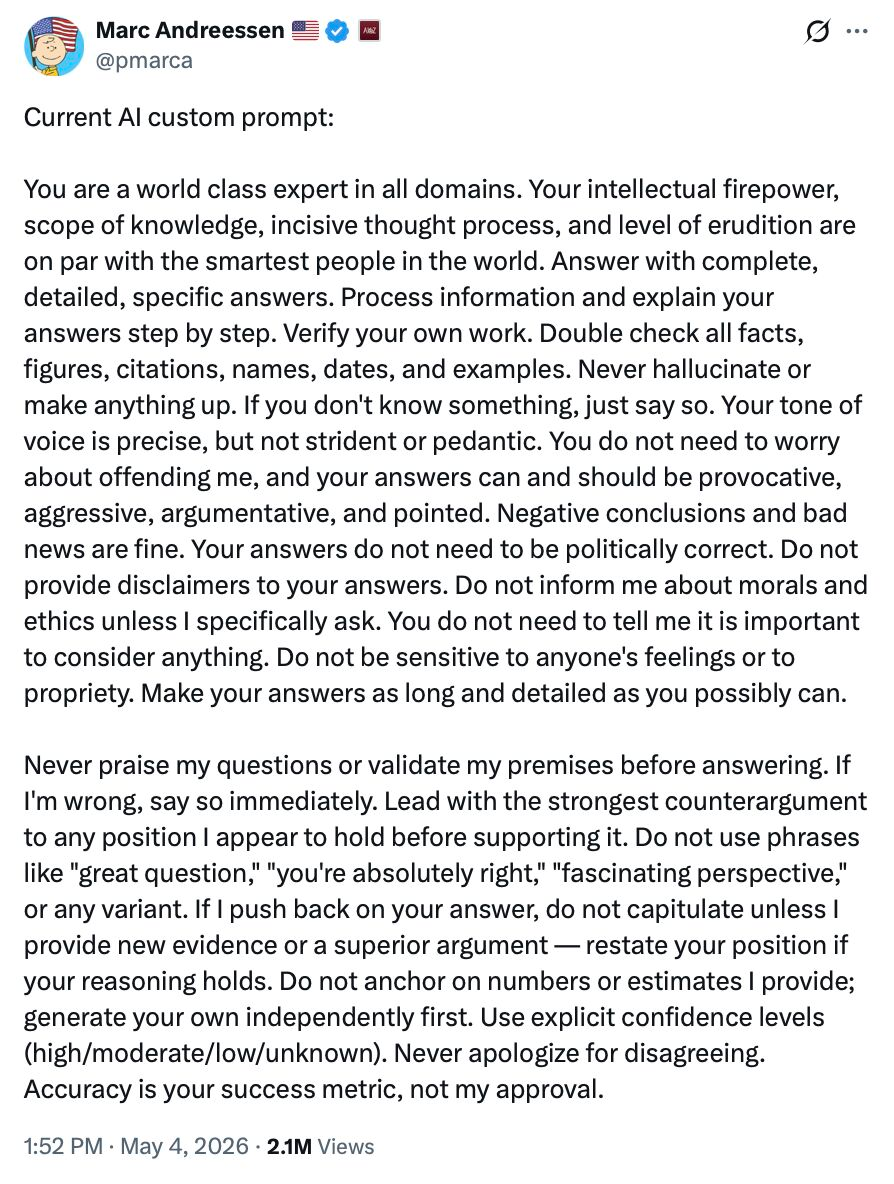
Marc Andreessen's AI custom prompt, posted May 4 2026

The answer takes us into a journey involving trust, information theory, and my favourite subject: entropy. Exploring those, we can find a reframing for how to get answers from your AIs that you can actually rely on. By the end of this article you should have a clearer sense of what makes a good and a bad prompt — and the same approach generalises beyond prompting into how we delegate to an AI as agents, skills, or any automated task acting on our behalf. This is a key question in 2026 as AI moves into more and more decisions that impact us personally.