Three weeks · One workflow · A specification your team can build against
Agreed boundaries. A clear path for human handover.
Agree the decisions before delegating the work.
When nobody has agreed what the system may decide, every exception becomes another meeting. Or a decision slips through without anyone owning it.
Decision Budget makes that boundary explicit, whether a pilot is waiting for approval, you are deciding what to build, or your team needs a consistent way of working before it can automate.
Your people keep accountability. The work identifies decisions they can delegate and the judgement they need to retain.
What would change in your team?
Explore three fictional workflows. Each shows the questions we investigate, the boundary you could agree, and the work that follows. These are illustrations, not client results or ready-to-use policies.
“Can we let the assistant reply to customers?”
The pilot drafts good answers. The support lead still checks every reply because nobody has separated routine queries from promises the company must honour.
Fictional scenario
Customer queryWhere is my order?
Check the boundaryIdentity verified? Current order record?
Both checks passReply with the recorded status.
Missing evidence or a new requestHold the reply. Route to the support lead.
What we investigate
Which source wins when systems disagree? Can the assistant promise a delivery date? Who owns a complaint or refund request?
What you agree
Status replies can be a candidate for delegation. Refunds and address changes stay with a person. Missing records trigger a named handover with a deadline.
What engineers build first
A reliable order lookup and handover log, then a shadow comparison against human replies. Promotion depends on agreed evidence.
“The extraction works. Can it process the invoice?”
Reading the fields is only one decision. Matching a purchase order, accepting a discrepancy and authorising payment need different rules and owners.
Fictional scenario
Incoming invoiceExtract the proposed fields.
Reconcile the recordsApproved supplier? Purchase order matches?
Agreed checks passPrepare a posting for human approval.
Mismatch or bank-detail changeHold and send to the finance owner.
What we investigate
What counts as a match? Who may accept a variance? What happens when an invoice has no purchase order?
What you agree
Extraction may prepare a draft. The authorised finance reviewer approves posting. Payment release and bank-detail changes remain human decisions.
What engineers build first
Matching rules, an exception queue and a test set containing duplicates and mismatches. Verify the controls before connecting downstream actions.
“Which answer is the assistant allowed to give?”
Your knowledge assistant finds three versions of a policy. A fluent answer does not tell you whether it used the current document or respected who can see it.
Fictional scenario
Retrieved documentsSeveral plausible answers.
Check the sourceCurrent and approved? Permitted for this reader?
Authoritative, accessible sourceAnswer with a citation.
Conflicting or unapproved sourcesWithhold a definitive answer. Ask the policy owner.
What we investigate
Who owns each policy? Which version is authoritative? Which readers may see it, and how are expired documents withdrawn?
What you agree
Answers must cite a current, permitted source. Conflicts go to the named policy owner. The assistant cannot invent a company policy.
What engineers build first
A source register and access checks, then tests for conflicting, expired and restricted documents. Measure unsupported answers before widening use.
A specification. An owner. A next step.
The agreed rules in two forms, plus an order of work. Use the pack with your own team or another supplier; it is useful without further purchases from us.
The decision envelope
An editable document and PDF recording the decisions identified in scope, operating limits, accountable people and exception handling. Open questions retain an owner and a date for resolution.
For the people agreeing how the work runs.
The engineering specification
The same envelope in a validated, machine-readable format. Both versions come from one source, keeping the agreed rules consistent.
For the people building and testing the system.
The first three build priorities
The first three pieces of work, with prerequisites, an owner and a testable definition of done for each. This may start with agreeing a standard or collecting evidence before building automation.
For the people deciding what happens next.
A fictional company. The real deliverables.
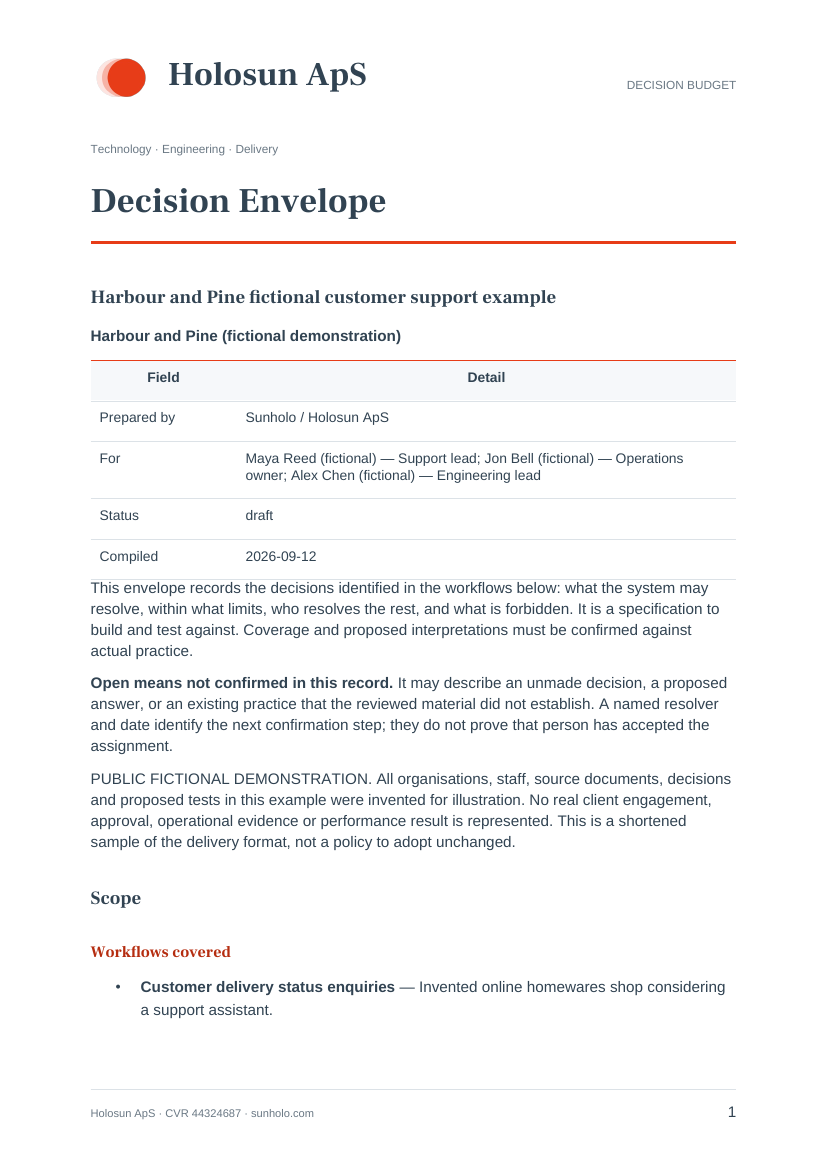
Harbour & Pine is an invented homewares shop considering a customer support assistant. Follow six decisions, four open questions and three build priorities through its sample handback.
These files were generated with our actual delivery software from one machine-readable source. The checks validate the specification's structure and consistency; no live system or performance results are claimed.
Each decision has its own starting point and ceiling. Progress depends on evidence from the previous stage. Some decisions stay with a person permanently.
1
Held
A person makes the decision.
2
Shadow
AI proposes privately. Compare its answer with the person's.
3
Checked
A person approves the AI decision before it takes effect.
4
Running
AI acts within agreed limits. Outside them, it stops and escalates.
Start with the material you already have.
Design documents, prompts, runbooks and incident reports. We do the preparation so your workshop time goes to the decisions only your people can settle.
Read and map
We extract the decisions, trace them to their sources and identify gaps.
Resolve together
For the standalone engagement, a half-day workshop with the people who can agree limits, ownership and success criteria. The opening phase of a larger engagement uses two sessions.
Agree the handback
Review the envelope and build order. Open questions retain an owner and deadline.
What does the 95,000 DKK pay for?
It pays for the investigation and agreement needed to turn your workflow into an implementable specification.
Find the decisions buried in the work. Read the agreed source material, reconcile conflicting instructions and trace findings back to evidence.
Prepare and run the decision workshop. Bring concrete gaps to the people with authority to close them.
Produce and validate your specification. Record limits, owners, deadlines and open questions in readable and machine-readable forms.
Sequence the build and hand it back. Define the first three priorities and review the result with your team.
Decision Budget
95,000 DKK fixed
One agreed workflow over three weeks. You provide existing material, join a half-day workshop, and review and confirm the outputs. Includes the envelope in both forms, the first three build priorities and a supporting measurement plan.
For a wider process
Up to three workflows or one cross-functional process: five weeks, 165,000 DKK fixed.
Within a larger engagement
A separately priced opening phase with two sessions and synthesis. Scope and price are agreed with a following phase in the same contract.
Is this the right next investment?
Compare the fee with a specific decision you need to unlock: a build commitment, a pilot launch or a workflow redesign.
A strong fit when…
People disagree about what the system may decide.
Exceptions keep returning to senior staff without a clear rule.
You need an agreed specification before commissioning implementation.
A smaller step may be enough when…
The rules, owners and acceptance criteria are already clear and the issue is an isolated technical defect. A focused engineering task may be the better starting point.
A useful question: Which upcoming commitment would you make differently if the boundaries and build order were agreed?
Before we begin
Do we need an existing AI pilot?
No. This works for a stalled pilot, a workflow you are about to automate, or a process that needs clearer decisions before it can be built.
Who needs to be involved?
The people who own the workflow and its consequences, alongside the people who understand how the work happens. Technical leads help translate agreed decisions into implementation.
What if we cannot answer every question?
An unresolved decision is a finding. We record who must resolve it, by when, and what it blocks. You receive an honest specification with explicit open questions.
Does this certify compliance?
No. We produce the specification and supporting evidence. Your legal advisers assess your obligations and whether the material meets them.
Does the engagement include building the system?
The engagement specifies controls and evidence requirements, and the build sequence sets out how to put them into practice. Implementation, model evaluation and system operation are separately scoped. The machine-readable file provides rules to build and test against; it does not enforce them in a running system.
Bring us one workflow.
Tell us what your team does, what you would like AI to take on, and where the uncertainty sits. We can work out whether Decision Budget fits.