Real exoplanets, real starlight: v0.4.0-dev.20

The voyage now reaches a real planetary system, the ship is lit by whichever star it is near, and the sky holds six times more stars, each in exactly one place.
What's new
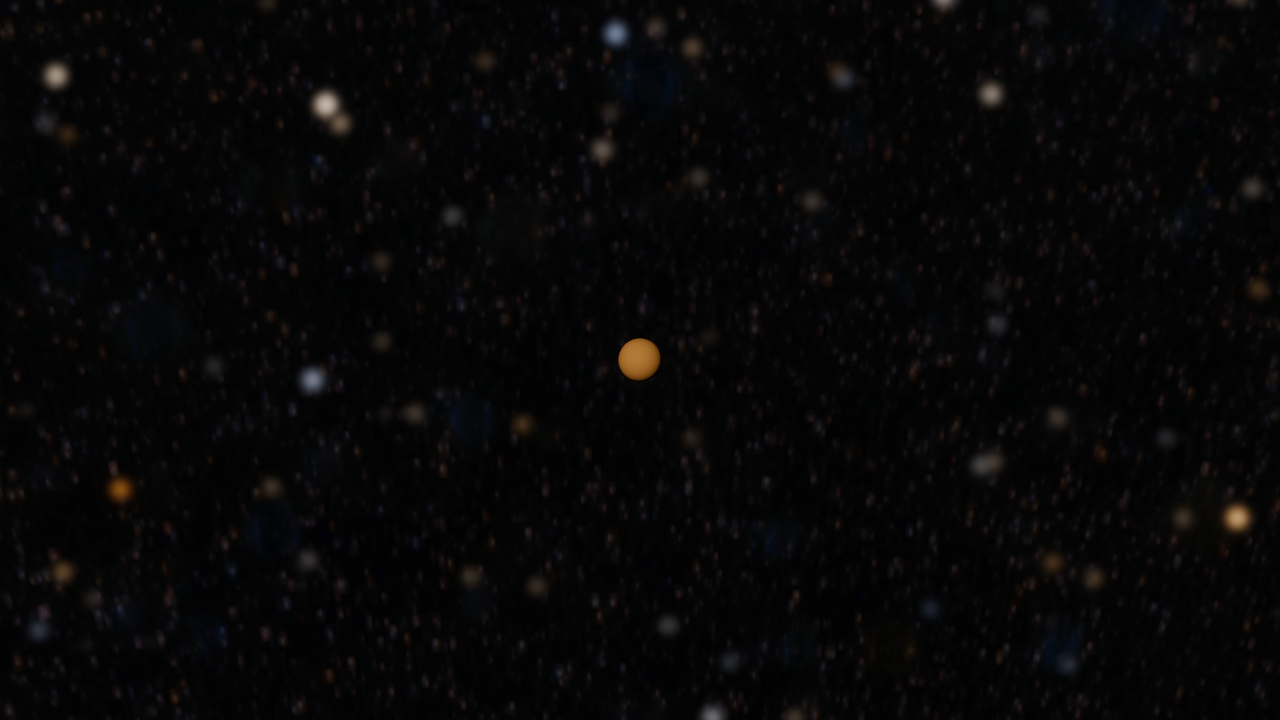
- TRAPPIST-1's seven planets. At the habitable-zone stop, planets b–h are where they really are when you arrive. Sizes and orbits come from Agol et al. 2021, positions from transit timings (Ducrot et al. 2020) corrected for 40.6 years of light travel. Planet e is 0.72° across, bigger than our Moon; c is a crescent and d half lit. Albedos and surfaces are assumed and labelled so.
- The ship lit by the real star. The bridge's key light comes from the Sun, or the star you are visiting, as seen through the bubble: its direction (aberration included), its colour (Doppler included) and a log-compressed brightness, labelled as not physical. Sun shadows sweep the deck as the ship turns; TRAPPIST-1 is a dim red glow; Aldebaran floods the deck with warm light. Deep space hands back to the ship's own lighting.
- Star colours (D-49). Auto view dims a star just enough to keep its hue and lifts its blackbody colour: Aldebaran golden orange, TRAPPIST-1 an ember. Realistic view is unchanged.
- A giant's approach. Aldebaran's final approach lasts 90 s, so the giant grows out of the starbow, blue-white at first from your own speed, turning golden as you stop.
- One position per star. Navigation and the sky now read a single truth table built in AILANG. Before, a map journey could arrive with the star drawn up to 8.7 ly away; now it's always ahead.
- The full 100 pc sky. 331,311 nearby stars from Gaia instead of about 50,000, for about 0.3 ms a frame.
Not yet
You can't fly to a TRAPPIST-1 planet yet, because its surface would have to be invented. The 100 pc sky's cost on a MacBook Air is an estimate (+1.3–1.8 ms) until measured.
Release: v0.4.0-dev.20-trappist-planets · Gallery · PRs #143, #146, #149.